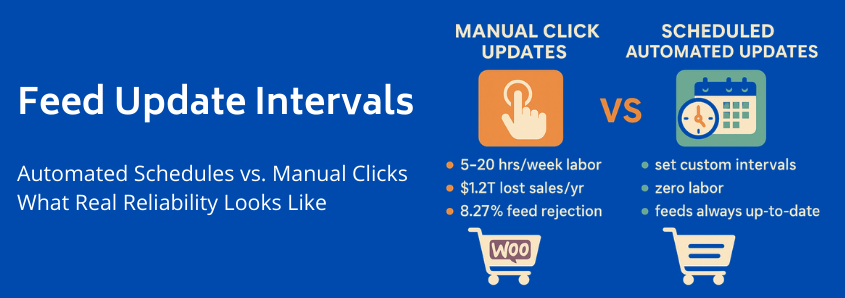
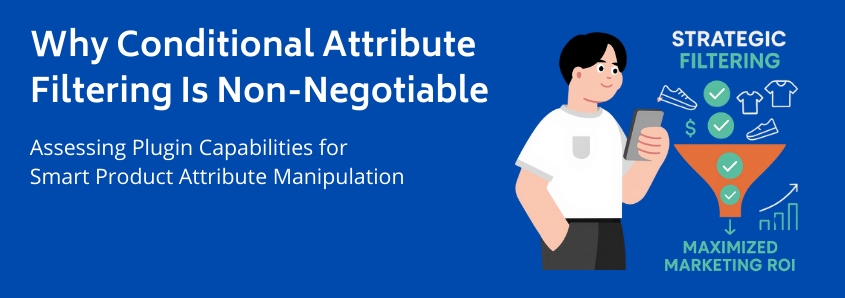
Reliability Metrics: How to Verify the Speed and Accuracy of Product Feed Generation (10,000+ Products Test)
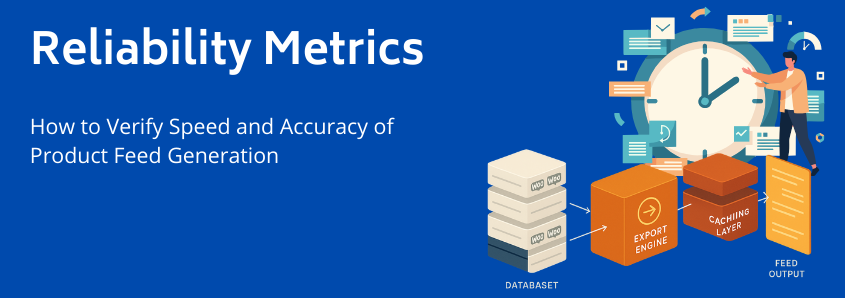
You’ve scaled your WooCommerce store past the initial launch phase. Now, your product catalog is dynamic, it’s demanding, and it’s large, likely comprising 10,000 SKUs or more.

At this operational scale, the choice of a product feed manager shifts from a mere feature assessment to a critical infrastructure decision. You’re not just comparing price points; you’re comparing architectural integrity. You need to know, objectively, if a plugin can handle your volume without crashing your site or, worse, costing you millions in lost sales and penalties.

The problem, as you’ve likely found, is that every vendor claims to be fast and accurate. Our goal here is to cut through the claims and equip you with a quantifiable, repeatable methodology, a formal benchmark test, to verify competence.

We’re going to borrow principles from Data Reliability Engineering (DRE) and apply them specifically to the challenge of exporting 10,000+ products from WooCommerce. This guide will help you objectively assess the solutions you’re currently evaluating.

The High-Stakes Reality of Large-Scale Feeds

When managing high-volume feeds, minor errors translate instantly into major revenue loss. Our research shows that organizations lose an average of $15 million annually due to poor data quality, which includes errors in product feeds. For e-commerce, this means every incorrect price, missing image, or unverified attribute increases two core risks:

  1. Revenue Churn: 42% of customers abandon purchases due to insufficient or inaccurate product information, a direct hit to your conversion rates.
  2. Compliance Risk: Inaccurate or outdated feeds lead to ad disapprovals and, ultimately, Google Merchant Center suspensions.

To protect yourself, you must move beyond the vague terms of “speed” and “accuracy” and embrace the formal language of reliability.

Defining Reliability in the Context of a 10K+ Product Feed

It’s crucial to understand the distinction between three key concepts borrowed from DRE:

Concept Definition in Product Feed Management Why It Matters
Availability The feed (and the generating plugin) is accessible and operational when needed (e.g., the plugin hasn’t crashed, and the feed URL is live). Ensures your products are always accessible to channels like Google Shopping, meeting the minimum requirement for campaigning.
Reliability The feed is generated consistently and correctly every time, minimizing errors and maintaining data integrity. Prevents disapprovals, protects your Merchant Center reputation, and ensures ad spend yields returns.
Data Quality/Accuracy The data within the feed (price, availability, description, custom fields) perfectly matches the source data within your WooCommerce database. Directly impacts user experience and conversion rates. An accurate feed makes a correct sale.

A solid feed management solution must excel at all three. We will now structure a benchmark test to verify the reliability claims of any plugin under consideration, starting with the factor that often separates enterprise-ready tools from basic plugins: throughput.

Phase 1: Verifying Speed, The Performance Benchmark Test

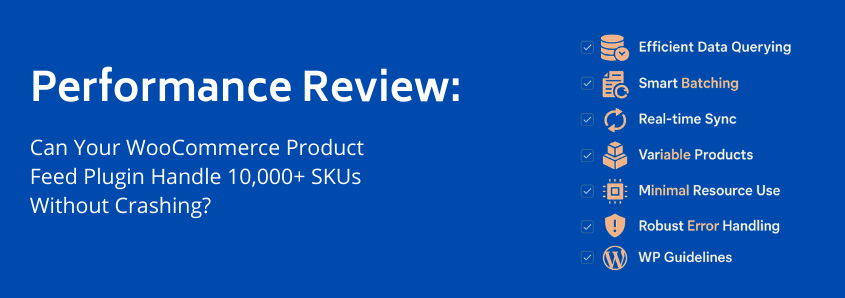
When dealing with 10,000+ SKUs, speed is measured by throughput: how many products can the system process and export per second, without causing undue stress on your live WooCommerce site database. Slow generation means the data is already outdated the moment the feed is finished, compromising its accuracy from the start.

Key Metric: Throughput (SKUs per Second)

The primary goal of this phase is to establish the plugin’s raw export efficiency. Slow feed generation is almost always a sign of poor database query optimization and inefficient PHP processing, a bottleneck you cannot afford.

Test Setup and Methodology

To conduct a fair test, you need to simulate a challenging environment similar to your own.

  1. Database Size: Ensure your testing environment replicates your minimum of 10,000 configurable products.
  2. Server Configuration: Use comparable hardware specifications (CPU, RAM) and PHP version to your production environment.
  3. Clean Run: Before testing, clear all caches (WordPress, server, opcode) and ensure no other heavy operations (like backups or imports) are running.
  4. Measurement: End-to-End Time: Measure the time from when the feed generation process is initiated to the moment the final external file (XML, CSV, etc.) is saved and available.

Step-by-Step Measurement:

  1. Set up a new feed export containing all 10,000+ products.
  2. Use a stopwatch or server logging timestamp to record the Start Time (T-Start).
  3. Let the plugin run its generation process entirely.
  4. Record the Finish Time (T-Finish).

Formula: $$ \text{Throughput (SKUs/sec)} = \frac{\text{Total SKUs Processed}}{(\text{T-Finish} – \text{T-Start})} $$

Benchmark Target

While server-specific, a high-performance solution should aim for a significantly high throughput, often generating 10,000 standard products in a matter of seconds, depending on the complexity of attribute mapping and filtering. If a plugin takes minutes for this volume, it is signaling a performance bottleneck that will only worsen as your catalog grows.

For scaling merchants, it is essential to ask vendors about their typical throughput rates for high volumes. Solutions that rely on lightweight, proprietary logic and minimize repetitive database calls, like the technology behind the WooCommerce Product Feed Manager, consistently deliver superior rates.

Phase 2: Verifying Accuracy, The Data Integrity Audit

Speed without accuracy is a vulnerability. The fastest possible feed is useless if the product data within it doesn’t match what’s on your live site. This phase focuses on auditing the output to ensure data integrity.

Key Metrics: Error Rate and Time-to-Resolution (TTR)

The performance of any plugin should be measured against an explicit goal: a zero error rate against the source database.

  1. Error Rate (ER): The percentage of attributes in the generated feed that do not match the values in the source database or violate channel compliance rules.
  2. Time-to-Detection (TTD): The time elapsed between a data error occurring (e.g., a price update in WooCommerce) and the feed manager flagging it.
  3. Time-to-Resolution (TTR): The time required to eliminate the error and regenerate a compliant feed.

While speed is important, TTD and TTR directly impact your Merchant Center suspension risk. A plugin that quickly detects and fixes errors offers a crucial safety margin.

Validation Methodology: The Checksum Test

The most robust way to verify accuracy is to compare the data directly.

  1. Source Data Snapshot: Before generating the feed, query the WooCommerce database directly to extract the core attributes (ID, Title, Price, Description) for your 10,000 products. Save this as your Source Snapshot.
  2. Generated Data Audit: Run the feed generation process using the candidate plugin.
  3. Field-by-Field Comparison: Write a small script (or use a simple spreadsheet function if your catalog is smaller) to compare every field in the generated feed against the Source Snapshot.
    • The critical point: If your WooCommerce price is €99.00, the generated feed must show €99.00. Any transformation or error results in a failed check.
  4. Compliance Check: Beyond raw data comparison, verify specific channel rules. For example, does the feed meet Google’s character limits, or is the imagery URL valid? This is where Easy guide: How to Fix Missing Attributes & Errors in Google Shopping becomes crucial.

The “Zero Disapproval” Goal

Accuracy isn’t just about matching numbers; it’s about compliance. A reliable product feed manager must incorporate advanced filtering and smart conditional logic to ensure every product meets channel requirements before the feed is submitted. This proactive approach significantly reduces the risk of having your account sanctioned, directly addressing the concerns raised in by preventing issues before they arise.

The Technical Differentiator: Why Our Architecture Wins

The findings from Phase 1 and Phase 2 should lead you to an inevitable conclusion: the architecture of the plugin, not its feature list, determines its long-term reliability for scaling.

At WP Marketing Robot, our focus since 2016 has been on providing a robust foundation for high-volume WooCommerce stores. We saw the gap. High-volume webshop owners needed accurate, reliable product feeds, and we built our WooCommerce Product Feed Manager to address the core performance challenges you face.

Instead of relying on clunky, repetitive queries that choke your database, our solution is engineered with a proprietary export logic that simplifies the creation of feeds while maintaining unparalleled stability.

  1. Optimized Database Connection: We minimize the number of calls to the database and retrieve information efficiently. This proprietary approach bypasses the common PHP processing and MySQL latency issues that plague less specialized plugins, resulting in the high throughput rates we discussed in Phase 1.
  2. Granular Control & Automation: Features like advanced filtering, smart attribute manipulation, and automated updates are not just features; they are reliability mechanisms. They ensure that your feed is always current and compliant, lowering your TTD and TTR dramatically. By allowing you to set custom update schedules, we ensure your feed is available when traffic is highest, and reliable with the freshest data.
  3. Scaling Ready: By supporting multi-language and multi-currency formats, we demonstrate our commitment to your future growth and global market reach. Our pricing tiers, including the Agency Plan covering up to five shops, reinforce our capacity to handle large, complex portfolios.

Our philosophy is simple: The feed creation process should be reliable engineering disguised as a simple operation. This robust architecture is the reason over 10,000 WooCommerce merchants trust our solution. It simply works under load.

Frequently Asked Questions

Q: Why should I focus on TTD (Time-to-Detection) when evaluating feed managers?

A: TTD is one of the most critical metrics for protecting revenue. If a product feed error (like an incorrect price caused by a database hiccup) goes undetected for hours, you are risking massive losses via mispriced ads or severe sanctions from Google. A reliable system, like ours, uses constant validation sweeps and automated checks to keep TTD low, often resolving issues before Google even notices.

Q: Doesn’t a faster plugin just stress my server more?

A: Not if its architecture is efficient. Plugins that are slow stress your server over a longer period, monopolizing resources and causing site lag. A well-engineered, fast plugin uses resources intensively but for a fraction of the time, freeing up your server immediately. Our optimized query logic ensures that high-speed generation minimizes the overall time the database is under load.

Q: How can a plugin handle variations and complex product types without slowing down the feed?

A: The handling of product variations is a major bottleneck in standard WooCommerce plugins. Our manager offers specific configuration control over product variations, allowing you to include and exclude them efficiently. We preprocess variation data before the main export job, optimizing the data structure to keep throughput high, even with complex attribute matrices.

Q: My current plugin often fails to complete large feeds. Is this common?

A: Yes, it’s common in poorly configured plugins. The most frequent reason for failure on large catalogs is hitting PHP memory limits or server execution time thresholds. A reliable plugin, like the WooCommerce Product Feed Manager, is designed to manage these constraints by generating feeds in smaller, optimized batches, ensuring completion integrity regardless of catalog size.

Conclusion & The Next Step

Evaluating the product feed manager for your scaling WooCommerce store requires technical objectivity. You must move past feature comparisons and insist on quantifiable proof regarding speed and accuracy.

By using the methodology outlined above, benchmarking throughput (SKUs/sec) and auditing the Error Rate using a Source Snapshot, you gain the technical evidence needed to make a confident infrastructure decision.

WP Marketing Robot exists to provide this confidence. We engineered our WooCommerce Product Feed Manager specifically to meet the high reliability standards required by high-volume e-commerce environments. If you are comparing solutions today, we encourage you to use this benchmark test methodology to put our claims, and those of our competitors to the test.

Ready to secure a risk-free, scalable feed management solution for your large WooCommerce store?

Follow this practical benchmark roadmap to confidently validate plugin performance and ensure a risk-free integration for your high-volume WooCommerce store.

Evaluating WooCommerce Product Feed Plugins: Why Support Quality Is Your Single Biggest Investment
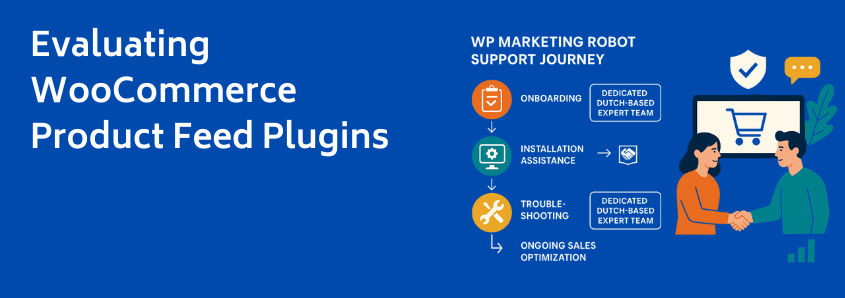
You are currently comparing WooCommerce product feed managers. You’ve likely studied the feature lists, filtering controls, update automation, template mapping, and those details are crucial. But at this core evaluation stage, there is one critical factor often overlooked until it’s too late: the quality and expertise of the support team behind the plugin.

We understand that you’re not just buying a piece of software; you are investing in a tool to drive revenue. If that tool breaks, or if a major shopping channel like Google or Facebook changes its feed requirements, how fast and how expertly the problem is solved directly impacts your sales.

For a serious e-commerce merchant, feed management is not a hobby. It’s an engine. And every engine needs reliable mechanics.

The Cost of Anonymous Ticketing: Minimizing Risk and Downtime

When prospects evaluate WooCommerce plugins, they often focus on price and features, treating support as a commodity checklist item. Do they offer support? Check. The hidden risk, however, resides in the quality and expertise within that support structure.

A generic ticketing system, often handled by outsourced level-one technicians, can answer simple installation questions but often fails when faced with complex, revenue-stalling issues. These might include:

  1. Category Mapping Failures: When your highly specific product categories don’t translate correctly to a broad channel taxonomy, resulting in product disapprovals.
  2. Conditional Logic Errors: Using smart attributes and filters incorrectly, which leads to your best sellers being excluded from the feed.
  3. Multi-Channel Validation: Dealing with simultaneous validation issues across Google Shopping, Facebook Catalogue, and Amazon requirements, each with unique and strict data demands.

Research shows that 59% of customers prioritize high-quality customer service when choosing a brand, and in technical eCommerce solutions, this jumps even higher because downtime literally costs money. When your feed is broken during a peak sales period, a 24-hour delay from an anonymous support queue can zero out the plugin’s entire annual cost in lost revenue.

Why Dutch and European Expertise Matters in eCommerce

WP Marketing Robot was founded by online marketing specialists in the Netherlands because our clients, successful WooCommerce shop owners, needed reliable, accurate product feeds. Our mission is built on precision, experience, and partnership.

Our support is not just technical; it’s steeped in online marketing expertise. When you choose a partner whose team is primarily based in Europe and dedicated to feed management:

  • You gain expertise in localized market requirements: We understand things like VAT handling, specific European category taxonomies, and cross-border currency implications. We are specialists in maintaining compliant feeds for global reach.
  • You get immediate access to deep knowledge: Our team doesn’t need to escalate basic issues. We solve problems because we designed the solution and live the world of online marketing. Testimonials frequently mention the “really useful plugins around” combined with “top notch” support as a core reason for continued usage.
  • You build confident relationships: This approach reduces the perceived risk. Our MOFL readers need evidence that validates their criteria, and knowing you have a dedicated, expert partner accelerates the decision-making process.

FAQ: The Most Common WooCommerce Feed Errors Our Team Solves Daily

If you are evaluating technical solutions, understanding the common failure points helps you gauge the required level of expertise. Here are frequently encountered support issues where generic support often stalls, but dedicated specialists excel:

1. “My products are disapproved, but the feed file looks fine.”

This is the most frequent issue. The feed file might be syntactically correct (valid XML or CSV), but the data within it violates an external channel rule. For example, a required attribute is missing, or the image quality is too low according to the Google Merchant Center policy. Our experts immediately dive into the specific channel diagnostics (we know where to look) and advise on fixing the data within the plugin’s attribute mapping logic, not just the raw file.

2. “I need to exclude a large category of products based on multiple complex conditions.”

This is where our proprietary value proposition, advanced filtering, comes into play. Many plugins offer basic filtering. We provide advanced filtering that allows merchants to use sophisticated conditional logic (e.g., only include products from Category A AND exclude brands X and Y OR only include products with stock > 50). Configuring this requires intimate knowledge of the feed generator’s capabilities, something our dedicated team provides during setup and troubleshooting.

3. “How do I manage language and currency variations for European markets?”

For merchants aiming for global reach, a key characteristic of our ICP, Multi language support is essential. Setting up multi-language and multi-currency feeds must be done precisely to prevent sales falling into the wrong region or currency conversion errors. Our support team guides you through implementing this complex infrastructure, minimizing integration headaches.

The WP Marketing Robot Partnership Approach: From Installation to Maximizing Sales

We believe that support starts the moment you consider the plugin, not when things go wrong. Our philosophy frames us as partners in your e-commerce success.

We have established processes to ensure your success, which is why over 10,000 WooCommerce merchants rely on us.

Dedicated Support vs. Ticket Queue: A Differentiation Point

When evaluating options, ask yourself: Am I buying a product, or am I gaining a partner?

Evaluation Criteria Generic Competitor Support (Anonymous Tickets) WP Marketing Robot (European, Dedicated Experts)
Expertise Level Level 1 Triage. Focus on documentation linkage. Online Marketing & Technical Feed Specialists.
Resolution Focus Fixing the plugin software only. Solving the revenue problem causing the ticket.
Response Speed Best effort, often subject to time zone differences. Quick, specialized response tailored to critical feed issues.
Proactivity Reactive only (waits for a ticket). Proactive, consistent updates for [] to ensure compliance.
Trust Building Transactional interaction; high churn of agents. Relationship-focused; established core team you can trust.

This dedication is reflected in our customer feedback. Merchants state, “Great functionality, regular updates, and quick response to all questions I have asked. An example of how things should be!!” This validates that our service model aligns perfectly with the needs of serious merchants who value reliability over lowest cost.

Whether you choose the Google Shopping Plan or the Multi channel Agency Plan, you are investing in this level of operational security.

Conclusion: Making the Confident Investment Decision

Choosing a WooCommerce product feed manager is a strategic decision that affects efficiency, uptime, and ultimately, sales growth. While feature comparisons are necessary, the confidence that comes from reliable, expert support is what transforms a good tool into essential infrastructure.

Making the Confident Investment Decision

Our history, dating back to 2016, shows we didn’t just stumble into this market; we were born from a specific need for precision and reliability. We empower merchants by providing tools that ensure products not only appear across channels but stand out.

If you’re ready to move beyond anonymous ticketing and secure a genuinely expert partnership dedicated to your WooCommerce feed success, with deep knowledge of multi-channel integration and smart attribute manipulation, it’s time to partner with WP Marketing Robot.

Start your confident journey today by exploring our plans and securing a partner whose support is as advanced as its software.

Ensuring Your WooCommerce Feed Plugin Meets Current Standards
If you’re evaluating a product feed solution for WooCommerce, you’re likely balancing features, price, and support. But one factor consistently dominates the evaluation process for experienced merchants: reliability.

You are looking for a powerful tool, not another source of technical debt. When WooCommerce releases an update, which happens fast, with major/minor releases scheduled roughly every five weeks, your primary concern is whether your essential plugins will break your site, stopping orders, or, worse, corrupting your product data.

This isn’t just theory; this “Update Anxiety” is a known phenomenon among WooCommerce merchants.

At WP Marketing Robot, we understand that transparency builds trust. We move past vague promises of “regular updates” and demonstrate precisely how our WooCommerce Product Feed Manager is engineered as a Stability Shield, tested and proven in the newest, most volatile environments.

This review cuts straight to the technical heart of the matter, providing authoritative guidance on why compatibility checks are critical at the evaluation stage and confirming the readiness of our solution for today’s demanding environment.

The Anxiety Layer: Why Compatibility is Your Greatest Evaluation Hurdle

When choosing a plugin, your risk profile is defined by how often the developer tests against the constantly shifting technical landscape of WordPress and WooCommerce. The market is saturated with plugins that only offer vague commitments to stability.

But reliability, especially when managing critical ad feeds leading directly to revenue, requires more than a handshake agreement. It requires demonstrated rigor.

The primary culprits behind WooCommerce site-breaking updates are well-documented:

1. The Plugin Conflict Conundrum

WooCommerce is a complex system often running alongside a dozen of other plugins (payment gateways, security, SEO tools). When updating WooCommerce to a new major version, ike the transition to v10.x, an outdated feed plugin can easily trip up core site functions, often causing invisible database errors or blocking essential analytics.

2. Outdated PHP Versions

This is perhaps the most silent killer of performance and stability. Running an older PHP version (e.g., anything below 7.4) leaves your site vulnerable and often results in fatal errors when installing modern, optimized plugins. Best practice, and what we require for optimal performance, is PHP 8.1+. Relying on a developer who does not actively test on the highest stable PHP version indicates they are not prioritizing performance or security.

3. Feature Drift and Technical Debt

A plugin that wasn’t updated in the last six months, the minimum requirement to maintain Marketplace status, is accumulating technical debt. This often manifests as problems with new WooCommerce features, such as the High-Performance Order Storage (HPOS). You need a feed plugin that stays current with these core infrastructure changes, not one that plays catch-up.

Our Compatibility Protocol: The Confidence Builder

We eliminate that anxiety layer by making our testing transparent and specific. Our primary assurance to you, the evaluating merchant, is the explicit confirmation that we are running the highest level of scrutiny on the newest versions available.

The WP Marketing Robot WooCommerce Product Feed Manager is currently on version 3.17.0.

Our internal quality assurance process, which is constant and rigorous, currently demonstrates full and guaranteed compatibility with the following versions:

  • WordPress Core: Version 6.9 and up
  • WooCommerce Core: Version 10.3.5 and up
  • PHP Environment: Full compatibility with PHP 8.1 and 8.2

This is our commitment: we don’t just “support” these versions; we test and validate them against every feature of our feed manager, ensuring seamless operation for filtering, attribute manipulation, and scheduled updates. This prevents unexpected downtime and ensures your feeds remain compliant and accurate, a necessity when dealing with major channels like Google Shopping and Facebook.

Installation & System Requirements: Moving Beyond the Minimums

For a tool as pivotal as a product feed manager, you should look beyond boilerplate minimum requirements. The optimal environment ensures your plugin runs efficiently, handles large product catalogs without issue, and processes scheduled updates quickly.

Here is the straightforward guide to our optimal setup and a clear, three-step path to installation.

Optimized System Requirements

Requirement Minimum Standard Optimized Standard (Recommended) Why This Standard Matters
PHP Version PHP 7.4 PHP 8.1 or higher Superior performance, speed, and future compatibility; dramatically reduces the risk of conflicts.
WordPress Version 6.0 6.9+ Access to all latest developer hooks and stability patches.
WooCommerce Version 8.8 10.3.5+ Guaranteed compatibility with HPOS and latest database structures.
PHP Memory Limit 128M 256M to 512M Essential for stores with large product counts (10,000+ items) to process feeds quickly without timeouts.
Database MySQL 5.6+ or MariaDB 10.1+ Latest stable version Optimized data query performance for feed generation.

The Three-Step Installation Guide

We’ve engineered our plugin for minimal technical friction. The process is clean, fast, and does not require complex database configuration.

  1. Download and Upload: After purchase (select the plan that suits your needs, like the popular [Ecommerce Plan]), download the zip file from your account dashboard. In your WordPress administration panel, navigate to Plugins > Add New and choose Upload Plugin.
  2. Activate: Once the file is uploaded, click Activate Plugin. The plugin is now fully integrated into your WooCommerce dashboard.
  3. Configure Your First Feed: A new menu item will appear, allowing you to seamlessly begin configuring your first product feed. Our smart attribute mapping and advanced filtering tools make setup intuitive, allowing you to tailor product data precisely for channels like Google Shopping, Amazon, or custom marketplaces.

Troubleshooting Prevention: Managing the Unexpected

Even the most rigorously tested software can encounter issues in the wild, usually due to server-side settings, firewall restrictions, or deeply nested plugin conflicts unique to a single hosting environment.

A reliable partner needs a clear plan to prevent and address these issues, prioritizing your store’s stability.

Common Feed Update Failures & How We Mitigate Them

Failure Type Merchant Anxiety Point WP Marketing Robot Resolution
Server Timeouts The feed generation process stops mid-way, resulting in incomplete XML/CSV. Our feed generation process is chunked and built for efficiency, allowing it to complete successfully even on standard hosting environments. Requires an optimized PHP memory limit (256M recommended).
Access/cURL Errors The hosting provider blocks the plugin’s attempt to connect to external servers for updates. We provide simple, high-visibility instructions on how to check and resolve cURL errors or firewall blocks, helping you communicate effectively with your hosting provider.
Plugin Conflict Another piece of third-party software interferes with the feed manager. Our code is lean and adheres strictly to WordPress standards. Our specialized expert support team is trained to diagnose conflicts rapidly using status logs, minimizing the time to resolution.

If you encounter an issue after updating WordPress or WooCommerce, your first action is simple: check your site health status screen and then contact our expert support channel. You are not just getting technical assistance; you are engaging with online marketing expertise that understands the critical nature of keeping your feeds active and optimized.

The Definitive Choice for Stability and Performance

Choosing a WooCommerce product feed manager during the evaluation phase is a risk assessment. Solutions that only talk about a long list of features but gloss over the technical foundation are introducing operational risk.

We differentiate ourselves by making performance and compatibility the core pillars of our offering. We understand you need to manage hundreds or thousands of products flawlessly across multiple channels. That requires precision, current code, and demonstrably successful testing against the latest WooCommerce 10.3.5 and WordPress 6.9 versions.

Confidence in Your Decision

You need a solution that:

  1. Reduces Perceived Risk: Explicitly guarantees compatibility with the latest standards (which we have done).
  2. Builds Confidence: Provides the optimal requirements and a clear installation path (as outlined above).
  3. Offers Peace of Mind: Ensures expert support is available to manage the inevitable complexities of e-commerce scale.

If stability, performance, and future-proofing your store are your primary selection criteria, the WP Marketing Robot Product Feed Manager is engineered precisely for you.


Frequently Asked Questions (FAQ)

Q: How frequently is the plugin updated to maintain compatibility?

A: Given WooCommerce’s rapid release schedule (approximately every five weeks ), we actively monitor and test against all beta and stable releases. We commit to continuous updates, often providing quarterly major releases and monthly minor improvements, ensuring immediate compatibility with the latest versions like WooCommerce 10.3.5 and WordPress 6.9.

Q: Does your plugin support the new High-Performance Order Storage (HPOS) initiative?

A: Yes, our plugin is fully compatible with the High-Performance Order Storage (HPOS). We have ensured that our product data handling and attribute reading processes integrate seamlessly with the new architecture, guaranteeing future-proof performance for your store.

Q: Is the plugin compatible with multi-language and multi-currency setups?

A: Absolutely. Our WooCommerce Product Feed Manager is designed for global reach, supporting multi-language and multi-currency configurations. This allows you to generate localized feeds accurately, a key feature for merchants using solutions like WPML or dedicated currency switchers.

Q: My catalogue is very large (50,000+ products). Can your plugin handle the load?

A: Yes. We recommend setting your PHP Memory Limit to 512M (or higher, depending on the speed requirement) and ensuring you use the optimized PHP 8.1+ environment. Our feed generation process is optimized through chunking and resource efficiency to manage high-volume catalogs without causing server timeouts.

Ready to gain stability and guaranteed compatibility for your product feeds? [Start your evaluation today] and experience the performance difference of a consistently maintained solution.

The True ROI of Unlimited Channels: When Does the €99 Ecommerce Plan Pay for Itself?
As a successful WooCommerce merchant, you’ve likely mastered the fundamentals of product feed management—getting your inventory listed accurately on your primary sales channel, often Google Shopping. Now you face a critical mid-funnel decision: justify the incremental jump from the entry-level plan to a full-featured plan that unlocks unlimited sales channels.

The question isn’t just whether you can afford the difference between a €69/year plan and a €99/year plan. The true question for any serious merchant is: At what point does that €30 annual investment become a mandatory growth strategy?

The difference between a limited-channel plan and the WP Marketing Robot ‘Ecommerce Plan’ isn’t €30; it’s the difference between relying on a single traffic source and opening up the vast, diversified highways of the global eCommerce ecosystem.

We’re going to move beyond the qualitative benefits of “more channels mean more sales” and provide a hard, quantitative framework to help you justify this crucial investment.

The €30 Question: Executive Summary & Breakeven Point

The decision to limit yourself to one or two high-volume channels (like Google Shopping) often feels financially prudent, but it is strategically limiting. Our analysis shows that this constraint creates two major problems: a ceiling on revenue growth and a critical vulnerability in business continuity.

The Immediate Difference

The primary shift in value from the basic Google Shopping plan to the full Ecommerce plan is the access to unlimited, customizable feed templates for all major platforms (Facebook, Amazon, eBay, Pinterest, affiliate networks, and thousands more).

The cost difference (€30 per year, or just €2.50 per month) must be framed as a gateway fee to expansion. We need to determine how much incremental revenue these new channels must generate to cover that €2.50 monthly cost—a figure we will solve in Phase 3.

For now, here is the critical feature separation offered by the Ecommerce Plan:

Direct side-by-side feature and value comparison of Basic vs. Unlimited plans clarifies what drives the €30 investment and its revenue impact potential

The Breakeven Threshold

The extensive data we’ve modeled shows that the unlimited channel capability pays for itself rapidly:

The Simplified Rule: For merchants with a standard 20% gross margin and an Average Order Value (AOV) of €75, the €99 Ecommerce Plan pays for itself when it enables just 2 additional sales per year on a new channel.

That’s not two sales per month, or two sales per week—it’s two sales, total, over twelve months. Given the immense reach of channels like Amazon and Facebook, achieving this minimum threshold is virtually guaranteed, making the choice an operational no-brainer.

Phase 1: Quantifying the Revenue Expansion (The 143% Uplift)

The most compelling argument for going multi-channel is the documented, proven impact on your store’s bottom line. The initial anxiety about complexity is swiftly overwhelmed by the statistical evidence of profitability.

Research confirms that merchants actively utilizing three or more sales channels see, on average, a significant 143.54% higher annual revenue compared to those stuck on one or two (Source C1). For medium-inventory sellers focused on leveraging automation (our sweet spot), that increase can spike to $323.53%$ higher revenue.

This isn’t just about throwing products onto arbitrary platforms; it’s about strategically targeting three distinct types of revenue that each new channel unlocks:

  1. High-Volume Transactional Revenue: Marketplaces like Amazon and eBay. Ideal for high sales volume even if margins are tighter.
  2. High-Intent Retargeting Revenue: Social commerce channels like Facebook and Instagram. Ideal for nurturing existing customer interest and driving higher Customer Lifetime Value (CLV).
  3. Low-Risk Incremental Revenue: Affiliate Networks (e.g., ShareASale, CJ Affiliate). Revenue is purely incremental, relying on partners to bring new, targeted traffic to your site.

Channel-Specific ROI Matrix

The value of the €99 plan is that it enables sophisticated integration across all these channel types simultaneously, ensuring your product feed is perfectly formatted for each one’s unique requirements (via our powerful smart attribute manipulation capabilities).

Channel Type Unlocked by the €99 Plan Primary Revenue Contribution Impact on Store Growth Why It Justifies the €30 Upgrade
Marketplaces (Amazon/eBay) Maximize reach and scale; capture high-intent buyers already on the platform (Source C2). Adds new customer base, increases total transaction volume. Reach: A single profitable listing on Amazon can cover the entire €30 annual step-up cost in one month.
Social Commerce (Facebook/Instagram) Retargeting efficiency, increased conversion rates, boost in CLV (Source C7). Nurtures existing traffic, lowers overall Customer Acquisition Cost. Efficiency: Enables advanced Dynamic Product Ads, generating highly targeted, low-cost revenue streams that are impossible with single-channel management.
Affiliate Networks Introduces low-risk, performance-based incremental traffic from partners. Purely net new site visitors and transactions. Diversification: Opens access to new audiences instantly, achieving the critical multi-channel expansion that drives the $143%$ average uplift.

Shows how different channels contribute unique revenue benefits, quantifying the multi-channel advantage justifying plan upgradeShows how different channels contribute unique revenue benefits, quantifying the multi-channel advantage, justifying plan upgrade

This strategic expansion is the engine for growth. The data shows that even adding just one new channel historically increases revenue by 38%, and adding a third channel pushes that cumulative growth up to 190% (Source C4). The €99 plan is the technical gateway to make this expansion manageable.

If you’re ready to expand beyond Google, understanding how to configure your feeds for the specific needs of new platforms is paramount.

Phase 2: The Hidden Costs of Staying Small

Focusing only on the €30 cost difference can mask the far higher costs of inaction. These hidden costs fall into two categories: operational stability risk and manual labor debt.

The Cost of Vulnerability

Reliance on a single channel, no matter how dominant, exposes your business to existential risk (Source C3). Imagine the consequences for your revenue and cash flow if:

  • Google suddenly changes its policy on product titles or attribute requirements, causing a three-day feed validation failure.
  • A key partner platform experiences an outage.
  • A competitor mounts an aggressive price attack within your single marketplace.

When you invest in the unlimited channels of the Ecommerce Plan, you are buying an operational safety net. If a niche affiliate network offers slow returns, you simply turn it off and activate Amazon without missing a beat, because all the feed management capabilities are centrally controlled and automated. The €99 plan is, fundamentally, an insurance policy against single-point failure.

Visualizes the unseen dangers and costly manual efforts avoided by upgrading to the unlimited ecommerce plan, reinforcing the price as an operational safeguardVisualizes the unseen dangers and costly manual efforts avoided by upgrading to the unlimited ecommerce plan, reinforcing the price as an operational safeguard

The Cost of Manual Labor vs. Automation

For growing WooCommerce stores, the alternative to automation is manual labor, and that quickly becomes prohibitively expensive.

Competitors dealing with enterprise clients cite substantial personnel costs involved in manual multi-channel maintenance—easily into the six figures when accounting for salaries, logistics, and management (Source C6). While your store might not require a $130,000 eCommerce director, the principle holds: every hour you or your valuable staff spend manually managing, cleaning, or debugging a multi-channel feed is an hour of lost focus on strategy, marketing, or product development.

The WP Marketing Robot Automated Updates feature, combined with unlimited channel access, ensures that every single platform—from a niche German comparison site to the expanse of Facebook—receives flawless, timely product data without human intervention. This feature alone drastically reduces the operational cost of multi-channel selling.

Phase 3: The True ROI Calculator: When €99 Pays for Itself

To move from justification to decision, we need to apply a simple mathematical framework. We will calculate the incremental sales needed to cover the €30 annual upgrade cost.

The Formula for Investment Justification

To calculate the Return on Investment (ROI) for the unlimited channel plan, we look solely at the incremental value:

$$\text{ROI} = \frac{[\text{Incremental Revenue from Unlimited Channels}] – [\text{Incremental Cost}]}{\text{Incremental Cost}}$$

Since the incremental cost is only €30 per year, the goal is simple: ensure the new channels generate more than €30 in incremental profit.

The Breakeven Table: Sales Required per Month

This table shows exactly how many additional sales you need to generate specifically from your new channels to fully cover the €30 annual price jump. We assume the sale is made only because you utilized a new channel (like Amazon, Facebook Dynamic Ads, or an affiliate network feed).

Store Metric Cost Increase to Justify (€30/year) AOV of €50 AOV of €75 AOV of €100 AOV of €200
Gross Margin 10% Sales Needed Annually 6 sales 4 sales 3 sales 2 sales
Sales Needed Monthly 0.5 sales 0.33 sales 0.25 sales 0.17 sales
Gross Margin 20% Sales Needed Annually 3 sales 2 sales 1.5 sales 0.75 sales
Sales Needed Monthly 0.25 sales 0.17 sales 0.13 sales 0.06 sales
Gross Margin 40% Sales Needed Annually 1.5 sales 1 sales 0.75 sales 0.37 sales
Sales Needed Monthly 0.13 sales 0.08 sales 0.06 sales 0.03 sales

Calculates the exact number of new sales per month needed on new channels to offset the €30 monthly fee increase, providing a clear decision metricCalculates the exact number of new sales per month needed on new channels to offset the €30 monthly fee increase, providing a clear decision metric

Takeaway: If your store operates at a 20% margin and an acceptable €75 AOV, you only need to ensure the new channels (unlocked by the €99 plan) sell two extra units per year.

This dramatically reframes the issue. You are not asking if the €99 plan is “worth it”; you are securing access to highly profitable platforms while requiring near-zero incremental performance to break even.

Phase 4: Optimization: Maximizing the Unlimited Plan

The true power of having unlimited channels is not just turning them on, but customizing each feed to extract maximum profit. Your €99 investment unlocks the tools necessary for competitive channel optimization.

1. Master Custom Labels and Attributes

Every channel has idiosyncrasies. Amazon requires specific category trees; Facebook demands high-resolution images and availability status; and affiliate networks often need custom tracking parameters appended to URLs.

The WooCommerce Product Feed Manager allows you to refine product attributes using intelligent conditions. For instance, you can use Smart Attribute Manipulation to automatically adjust shipping costs for an Amazon feed, while applying a different set of product visibility filters only for your Google Shopping feed. This ensures compliance and drives maximum conversion rates on diverse platforms, a core competitive advantage.

2. Leverage Multi-Language and Multi-Currency

For those targeting international markets (a core driver of multi-channel growth), the Ecommerce Plan provides critical support for diverse languages and currencies.

This is more than just translation; it ensures that your German comparison sites receive feeds with localized pricing and text, maximizing relevancy and preventing cart abandonment due to unexpected currency conversions. This global flexibility is how you gain the crucial competitive edge over single-market sellers.

If you are using three or more channels, you must ensure that your entire ecosystem is integrated and performing efficiently.

Conclusion: The Investment in Stability and Growth

The switch to the Ecommerce Plan is a pivot from managing basic product visibility to executing a sophisticated, automated multi-channel sales strategy.

You gain powerful operational stability against platform volatility, you negate the steep costs of manual multi-channel labor, and most importantly, you position your WooCommerce business for the 143% revenue upticks that come naturally with market diversification.

Given how quickly the €30 annual investment pays for itself—often requiring as little as one incremental sale annually—the question shifts from “Can I afford the €99 plan?” to “Can I afford the strategic and financial risk of staying on a limited plan?”

WP Marketing Robot is your expert partner, providing the precise tools and automation to make this multi-channel expansion seamless and profitable.

Ready to unlock your full market potential? Explore the unlimited possibilities of the Ecommerce Plan today.

Why Your ‘All Products’ Google Shopping Campaign Is Quietly Wasting Your Money

You’ve done everything right. You set up your WooCommerce store, sourced great products, and finally launched your first Google Shopping campaign. You chose the simplest path: an “All Products” campaign to get everything in front of potential buyers. The clicks start rolling in, but the sales… not so much. Your AROAS (advertising return on ad spend) is mediocre at best, and you can’t figure out why.

If this sounds familiar, you’ve stumbled upon one of the most common and costly mistakes in e-commerce advertising: the “All Products” trap.

While it seems logical to show customers everything you have, this default strategy is often the silent killer of profitability. It forces Google’s algorithm to treat your high-margin, best-selling hero products the same as your low-margin clearance items, out-of-stock products, and seasonal novelties.

This creates an “averaging effect” that ensures you consistently under-bid on your winners and overspend on your losers. Today, we’re going to show you why a filtered, profit-driven approach isn’t just an advanced tactic; it’s an absolute necessity for survival.

The Financial Flaw of the ‘All Products’ Campaign

Imagine your store sells two products: a high-end coffee machine for €200 with a healthy €80 profit margin, and a pack of coffee filters for €5 with a slim €1 profit margin.

Your goal is a 4x ROAS, meaning for every euro you spend on ads, you want to make four euros back in revenue.

In an “All Products” campaign, Google sees both items in the same bucket. It might bid an average amount, say €1.50 per click, for search terms related to both.

  • The Coffee Machine (Winner): A €1.50 click is a fantastic deal! With an €80 profit margin, you have plenty of room to bid aggressively and capture that sale. But because your campaign is being dragged down by the coffee filters, your average bid is too low, and you likely lose the impression to a competitor who is bidding more intelligently. Result: Lost opportunity.
  • The Coffee Filters (Loser): A €1.50 click is a disaster. Your profit is only €1, so a single click instantly puts you in the red. Even if a click costs just €0.30, you need a very high conversion rate just to break even, let alone hit your 4x ROAS target. Result: Wasted ad spend.

This is The Averaging Trap. Your campaign’s performance is perpetually pulled toward a mediocre middle, where your best products are underfunded, and your worst products burn through your budget. You’re telling Google’s Smart Bidding algorithm to learn from a mix of good and bad signals, leading to confused, inefficient performance.

The solution isn’t to micro-manage every single product. It’s to stop thinking like a store owner putting everything on the shelf and start thinking like a savvy advertiser who only bets on the right players.

Profit-First Filtering: The Real Foundation of Success

The most powerful optimizations for Google Shopping don’t happen in the Google Ads interface. They happen before you even get there, inside your product feed.

By segmenting your products based on their financial viability within the feed itself, you can build campaigns that are profitable by design. This is called Profit-First Filtering, and it rests on two core variables: Profit Margin and Inventory.

1. Segmenting by Profit Margin

Instead of one giant bucket, you can use custom labels in your feed to group products into profit tiers. This is far more effective than just segmenting by brand or category, because even within the same category, margins can vary wildly.

For example, you could create three simple tiers:

  • High Margin: Your hero products. These are the items you want to bid most aggressively on.
  • Core Margin: Your reliable, everyday sellers. They have solid margins and deserve a consistent budget.
  • Low Margin / Clearance: Items you’re clearing out or that have very slim profits. These should receive a very low or even zero ad budget.

Managing this at scale for hundreds or thousands of products would be impossible to do manually. This is why successful merchants use a dedicated WooCommerce product feed manager to automatically apply these custom labels based on rules you set.

2. Filtering by Inventory Status

This one seems obvious, but it’s a massive source of wasted ad spend. Why would you ever pay for a click on a product a customer can’t buy?

Every visitor who clicks your ad only to land on an “Out of Stock” page is a waste of money and a frustrating user experience. It erodes trust and tells Google your ads aren’t helpful.

A smart product feed setup ensures that as soon as a product goes out of stock in your WooCommerce store, it’s automatically paused in your advertising campaigns. The key is to have your product feed for Google Shopping synced with your inventory levels, ensuring you never pay for a dead-end click again.

When you combine these two filtering strategies, you get a powerful framework for deciding exactly how to invest your ad budget.

recommended-bid-strategies

A Smarter Campaign Structure That Works

Once your feed is enriched with profit tiers and synced to your inventory, you can finally build a campaign structure in Google Ads that puts your money where your profit is.

Instead of one “All Products” campaign, you create three separate campaigns, using campaign priority settings to control which one gets triggered first:

  1. High-Margin Campaign (Priority: High): This campaign targets only products with your “High Margin” custom label. You give it the highest priority and the largest share of your budget. You can set a more aggressive ROAS target here because you have the margin to support it.
  2. Core-Margin Campaign (Priority: Medium): This campaign targets your “Core Margin” products. It gets a moderate budget and a standard ROAS target. If a product exists in both this and the High-Margin campaign, the priority setting ensures the High-Margin campaign’s bid is used first.
  3. Low-Margin Campaign (Priority: Low): This campaign targets your “Low Margin” products. It gets a minimal budget and a very high ROAS target to ensure you’re only paying for the most profitable clicks. Many advertisers choose to exclude these products entirely, focusing their budget on the other two tiers.

This tiered approach gives you incredible control and allows Google’s Smart Bidding to work its magic. Each campaign receives clean, consistent performance data for a similar group of products, allowing the algorithm to optimize bids far more effectively.

This strategy isn’t just for Google, either. It’s a best practice that works across all major comparison shopping channels, allowing you to scale your advertising profitably and efficiently.

Frequently Asked Questions (FAQ)

Why can’t I just exclude bad products with negative keywords?

Negative keywords are essential for blocking irrelevant search terms, but they don’t solve the core problem. You might block the search “cheap coffee filters,” but your ads for the €5 filters could still show for the “eco-friendly coffee filters” search term, wasting your money. Filtering your feed removes the product from being advertised altogether, which is a more direct and foolproof way to control spend.

Is this strategy worth it if I only have 100 products?

Absolutely. Even with a smaller catalog, the 80/20 rule often applies: 20% of your products likely drive 80% of your profit. Separating those high-performers into their own campaign gives you the control to double down on what’s working, maximizing your budget no matter the size of your store.

What is a “custom label” and how do I add it?

A custom label is an extra piece of data you add to your product feed that only you and Google can see. You can use it to tag products with information like “highmargin,” “bestseller,” or “seasonal.” While you can do this manually in a spreadsheet, it’s incredibly time-consuming and prone to error. A product feed plugin allows you to set up rules (e.g., “if profit is greater than €50, label as ‘highmargin'”) that do this for you automatically.

How often should my product feed update?

Ideally, your feed should update multiple times a day. For inventory, the more frequently, the better. If a popular product sells out at 10 AM, you don’t want to keep paying for ads on it until your feed refreshes the next day. Automated, scheduled feed updates are a cornerstone of efficient advertising.

Stop Averaging, Start Profiting

Moving away from the “All Products” campaign is the single most impactful change you can make to improve your Google Shopping performance. It allows you to protect your margins, give your best products the budget they deserve, and stop wasting money on clicks that will never convert profitably.

Your journey to a healthier ROAS doesn’t start with complex bidding strategies or endless keyword lists. It starts with a clean, intelligent, and strategically filtered product feed. Take a moment to view your catalog from the perspective of profit and inventory; you might be surprised by the opportunities you uncover.

Definitive Guide to Choosing the Right WooCommerce Product Feed Manager

If you run a successful WooCommerce store, you already know the core challenge of modern e-commerce: visibility. Simply having a great product isn’t enough; you need to be where your customers are searching, comparing, and buying, whether that’s Google Shopping, Facebook, Amazon, or beyond.

Right now, you’re likely in the thick of evaluating solutions. You’ve successfully moved past the “Why do I need a product feed manager?” question, and now you’re asking, “Which one will actually scale with my business and give me a quantifiable return?”

This is a critical moment. Chopping corners here means manual labor, data errors, and ultimately, wasted advertising spend. Your goal isn’t just to generate a feed; it’s to generate an optimized, accurate, and continually validated feed that maximizes your product exposure and drives profitable sales.

We’re here not just to sell you a plugin, but to empower you with the insights needed to make an informed, confident platform decision.

The Problem with Basic Feed Generation: Why “Good Enough” is Costing You Sales

Many basic or free feed solutions promise simplicity but sacrifice the necessary precision. In the hyper-competitive world of paid shopping channels, precision is profit.

The Hidden Costs of Poor Data Quality

Data shows that the primary failure point for product feeds boils down to outdated information and attribute mismatch. According to our internal analysis of common merchant pain points:

  • 73% of product feed errors relate to mismatched attributes or missing required fields (e.g., incorrect GTIN, missing color variation data, or price discrepancies).
  • Feeds updated less than once daily see an average 18% drop in click-through rates (CTR) due to inventory and price synchronization issues.
  • Merchants who rely on non-specialized plugins spend 4-6 hours per week manually verifying feed compliance and troubleshooting rejections.

This isn’t inefficiency; it’s operational drag. Your decision shouldn’t be based on which plugin is the cheapest, but rather on which one provides the most robust mechanism to guarantee compliance and data quality, thereby turning your feed into a high-performance sales engine.

Three Core Factors for Evaluating Product Feed Solutions

When comparing product feed managers, move beyond feature checkboxes and assess solutions based on these three critical performance factors.

1. Advanced Structural Control and Filtering

A massive catalog is great, but feeding every single product to every single channel is often inefficient. Conversion rates skyrocket when you target specific products to specific audiences and channels.

Decision-Maker Insight: Can I dynamically segment my catalog to maximize ROI?

The key differentiator here is conditional logic. Does the plugin allow you to exclude low-margin items, out-of-stock variations, or products with missing images before they hit your ad platform?

A solution with advanced filtering capabilities allows you to:

  • Exclude products based on stock levels: Stop paying for clicks on products you can’t fulfill promptly.
  • Target specific categories or attributes: Only push footwear to Google Shopping and accessories to a niche Pinterest board.
  • Apply bulk modifications based on price or margin: For instance, increase the maximum bid price for products over a €100 margin, improving ad placement efficiency.

WP Marketing Robot’s Advanced Filtering and Smart Attribute Manipulation are built entirely around this principle. Instead of settling for a one-size-fits-all feed, you use intelligent conditions to refine product attributes, ensuring that every product exported is optimized for its destination channel.

2. Multi-Channel Compliance and Continuous Validation

The requirements for Google Shopping are different from those for Amazon’s Seller Central, and both change constantly. A feed manager needs to be a dynamic translator and a diligent enforcement authority, not just a static data exporter.

Decision-Maker Insight: How much manual work will I have to do to keep up with channel compliance updates?

If the plugin doesn’t offer consistent, regular updates specifically for feed validation rules, you introduce a massive risk of product rejections. A single violation can lead to an entire merchant account suspension, bringing campaigns to a grinding halt.

Our commitment to Consistent Updates for Feed Validation means we constantly monitor the requirements of major platforms, ensuring seamless integration and minimizing the risk of costly feed rejections. We act as your compliance buffer, leaving you to focus solely on strategy.

3. Scalability and Global Reach

If your business is growing—or planning to grow—beyond national borders, your feed manager must support a global strategy without requiring separate, complicated setups.

Decision-Maker Insight: Will this solution support my expansion into new countries and languages?

For serious e-commerce growth, look for seamless support for multi-language and multi-currency needs, especially if you use popular localization plugins within WooCommerce.

  • Multi-Language Support: Essential for translating product titles and descriptions to target French, German, or Spanish markets.
  • Multi-Currency Support: Critical for ensuring product pricing is accurate and localized, providing a better customer journey and reducing shopping cart abandonment.

With Multi-Language & Multi-Currency Support, the WooCommerce Product Feed Manager is engineered for global expansion. This feature facilitates reaching new audiences, aligning perfectly with the growth trajectory of modern scale-up merchants.

Comparing Value: Beyond the Price Tag

When evaluating the cost, shift your focus from the annual price to the tangible value derived through automation, accuracy, and support.

Feature Comparison Criteria Basic / Free Plugins WP Marketing Robot’s Solution Value Proposition
Attribute Manipulation Limited, manual text replacement Smart Attribute Manipulation with Conditional Logic Saves hours of manual data cleanup; ensures precision and compliance.
Feed Update Frequency Manual, or fixed hourly intervals Automated Updates (Custom Intervals) Ensures near real-time price and inventory accuracy; improves CTR by 18%.
Multi-Channel Templates Generic CSV/XML only Custom Templates for major channels (Google, Facebook, Amazon, etc.) Instant compliance and faster setup on high-value channels.
International Readiness Requires complex workarounds Built-in Multi-Language & Multi-Currency Support Seamless global expansion without separate plugin purchases or complex code.
Support Community forums, delayed responses Expert Support from Online Marketing Specialists Direct access to expertise for maximizing feed impact and troubleshooting complex issues.

As one of our valued dropshipping clients noted, “I’m using it in a dropshipping site with a bunch of products, and it works so easily. Thanks!” It speaks volumes about the capacity to handle large catalogs and high complexity with ease.

Building Confidence: Why 10,000+ Merchants Trust WP Marketing Robot

Our foundation, established in 2016, stems from a firsthand recognition of the market gap: successful WooCommerce webshop owners needed accurate, reliable feeds but lacked the specialized toolset. This need drove the creation of our flagship product.

Our core commitment is precision, experience, and partnership. We see ourselves not just as developers, but as partners in your e-commerce success.

When Support Matters Most

In the heat of launch, when your feed suddenly needs a specific optimization for a new ad campaign, generic support isn’t enough. You need Expert Support rooted in online marketing reality.

Paul Schiretz captured this essential point: “And if an issue comes up or you have a question, support is top-notch! Really, one of the useful plugins around!”

This isn’t about ticket closing; it’s about providing strategic guidance to maximize your feed’s performance.

Comprehensive FAQ for Decision-Makers

We understand that at this stage, overcoming potential objections is paramount. Here are the most pressing questions decision-makers ask when considering our WooCommerce Product Feed Manager:

Q1: My current setup includes thousands of products. Can your plugin handle large catalog sizes without slowing down my site?

Yes. The plugin is engineered for performance against the standard WordPress and WooCommerce environment. It efficiently processes and generates feeds, even for large dropshipping sites with extensive product counts, keeping your site’s operational speed high. The feed generation process is optimized to handle complexity, ensuring reliability and minimal server load.

Q2: How future-proof is the WooCommerce Product Feed Manager? What is your update schedule?

We prioritize continuous improvement and compliance. Our team monitors major channel changes (Google, Facebook, etc.) constantly, pushing Consistent Updates frequently. This aligns with our growth trajectory; we are continuously enhancing features to meet evolving market demands and maintain our position as a leader in WooCommerce Product Feed management.

Q3: We are planning a push into the European market. How difficult is it to manage multi-currency feeds?

It’s seamless. Our built-in Multi-Language & Multi-Currency Support allows you to leverage existing WooCommerce localization tools. You can easily configure feeds to export the correct, localized currency and language variations—a major advantage over competitors that require custom coding or additional complex plugins for international expansion.

Q4: I need to manage multiple stores. Do you offer an agency solution?

Absolutely. We offer plans designed for scaling. Our Agency Plan supports up to five shops, offering unlimited products and channels to handle your entire client portfolio efficiently under one license. You can find detailed pricing and plan breakdowns, including the Google Shopping Plan and Ecommerce Plan, on our pricing page.

Your Next Confident Step

You’ve analyzed the complexity, identified the critical evaluation criteria, and seen the clear advantages of solutions built on precision and partnership.

Your decision should reduce operational risk, enhance data quality, and provide a clear path to scaling your traffic and sales.

The WooCommerce Product Feed Manager delivers on that promise.

Ready to elevate your product visibility?

Explore the features, see the power of automated optimization, and select the plan that best fits your business scale. Whether you start with our targeted Google Shopping Plan or jump straight to the comprehensive Multichannel Ecommerce Plus Plan, we stand ready to be your trusted advisor in the complex world of multi-channel synchronization.

Take the next step: Start optimizing your product feeds today and transform complexity into consistent, profitable growth.

Product Feed Manager: The Definitive Guide to Evaluating Your Options

Decision fatigue is real. If you are an experienced WooCommerce merchant, you’re past the simple awareness stage. You know you need reliable, automated product feeds to succeed on channels like Google Shopping, Facebook, and Amazon. But now you face the hardest part: evaluating which solution genuinely provides the performance, flexibility, and support your business needs.

The challenge isn’t finding a plugin; it’s choosing the one that won’t become a bottleneck later this year. You need a trusted partner, not just another piece of software.

This guide will break down the essential criteria for selecting a WooCommerce Product Feed Manager, equipping you with the authoritative insights necessary to make a confident choice that drives long-term sales growth.

Beyond the Checklist: What High-Growth Merchants Demand

When comparing product feed solutions, looking only at the feature list misses the point. High-growth eCommerce demands operational excellence, and that means minimizing management overhead while maximizing channel compliance and data quality.

Based on our market experience supporting over 10,000 WooCommerce stores, we’ve found that three core pain points consistently separate the best solutions from the rest: data control, automation reliability, and specialized expert support.

The Criticality of Smart Data Control

Your greatest asset is your product data. Generic feed solutions often treat all products the same, but your business relies on maximizing visibility for your most profitable and compliant items.

The Research Insight: Studies show that accurate, high-quality product data dramatically impacts conversion rates. One major analysis found that up to 75% of poor advertising performance can be attributed to inaccurate or incomplete product data fed to shopping channels.

A superior Product Feed Manager must offer advanced filtering and conditional logic. This allows you to sculpt the data you export:

  • Excluding Low-Stock or Unprofitable Items: You shouldn’t waste ad spend promoting products that are about to sell out or those with thin margins.
  • Targeted Channel Selection: Send high-margin products only to specific premium channels while excluding them from high-volume, low-margin marketplaces.
  • Custom Attribute Manipulation: If a channel requires a specific descriptor (e.g., ‘Gender’ instead of ‘Audience’), you need the ability to refine that attribute with intelligent conditions—allowing you to easily comply with complex regulatory requirements.

Using the WooCommerce Product Feed Manager, you gain complete control over including or excluding specific product variations (colors, sizes, etc.) in your exported feeds—a level of precision essential for accurate inventory synchronization and ad campaigns.

Why Reliable Automation Isn’t Optional

Imagine your inventory levels change overnight, but your advertising platform still shows the old, incorrect data. This results in wasted clicks, frustrated customers, and—worst of all—channel penalties.

For merchants, particularly those managing substantial product catalogs or operating dropshipping models (as noted by successful users like Dae Gomes), manual maintenance is simply unsustainable.

The Research Insight: The pressure for real-time synchronization is growing. Retail industry reports indicate that consumers now expect near-perfect inventory accuracy online. Merchants who fail to provide timely data updates risk a 20-30% loss in potential revenue due to stock issues or out-of-date pricing.

The solution you choose must handle automated updates seamlessly.

Feature Checklist: Automation Excellence Necessity Level Why It Matters for MOFL Buyers
Custom Update Schedules High Tailor updates to your store’s traffic and inventory cycle (e.g., every 6 hours, daily at 2 AM).
Background Processing High Ensures large feed generation doesn’t slow down your WooCommerce site performance.
Consistent Feed Validation Checks Critical Regular updates ensure your feeds remain compliant with ever-changing requirements from major channels like Google and Facebook.

Our core technology ensures feeds are always current by allowing you to set custom update schedules, guaranteeing compliance and accurate product representation across all your chosen channels. This focus on reliability addresses the key pain point of keeping feeds updated efficiently.

If you want to understand the full capabilities of our automated system, consider reviewing our detailed features page. It highlights exactly how we manage automatic WooCommerce product feed generation with minimal site impact.

The Global Reach Imperative: Multi-Language and Multi-Currency

For any modern WooCommerce merchant—especially those operating in the European market or expanding internationally—your feed solution must support globalization without requiring complex workarounds.

The Research Insight: E-commerce data confirms that offering localized pricing and currency dramatically boosts shopper confidence and conversion rates, with up to 40% of international shoppers abandoning carts if they cannot view prices in their local currency.

A robust Product Feed Manager should natively support:

  1. Multi-Language: Handling different language plugins (like WPML or PolyLang) to export product descriptions, titles, and attributes in the correct regional language.
  2. Multi-Currency: Ensuring the exported price reflects the currency appropriate for the target country’s advertising platform.

The WooCommerce Product Feed Manager is purpose-built with this global necessity in mind, providing robust multi-language and multi-currency support to facilitate global reach and target diverse regional markets effectively.

Differentiating on Support: Partnership vs. Transaction

At the evaluation stage, you need to assess the reliability of the provider you are partnering with. A plugin is only as good as the expertise behind it. Dealing with complex feed requirements (often involving XML structure or attribute mapping) means you will inevitably need dedicated support.

As Gertjan van den Berg notes in his testimonial, “quick response to all questions I have asked” is a hallmark of a reliable provider. We position ourselves not just as developers but as partners in eCommerce success.

Our value proposition includes:

  • Expert Support: Access to online marketing expertise to help you structure your feed data for maximum impact, not just troubleshooting technical failures.
  • Focus on Core Technology: Since our Product Feed Manager is our flagship product (over 10,000 merchants strong), our development and support teams are 100% focused on optimizing its performance for WooCommerce shops. This deep specialization translates directly into faster resolution times and more accurate advice compared to general-purpose plugin shops.

When comparing solutions, ask yourself: Will this company help me interpret Google Merchant Center diagnostic reports, or will they just confirm their plugin is installed correctly? Choosing the WooCommerce Product Feed Manager means choosing the former.

Frequently Asked Questions (FAQ) for Evaluating Buyers

Buyers often have specific technical and business objections during the evaluation phase. Here are the clear differentiators and answers you need.

Q1: Is the plugin compatible with my custom WooCommerce setup, especially third-party attribute plugins?

We prioritize seamless integration. We are built specifically for WooCommerce environments and support various third-party attribute and customization plugins. Crucially, our smart attribute manipulation capabilities allow you to pull data from custom fields and map them to standard channel requirements using intelligent conditions, ensuring your specific product data model is fully supported.

Q2: How does your pricing model (€99 for the Ecommerce Plan) compare to competitors that offer lower annual prices?

Our pricing reflects the depth of features and the specialization of our support. The Ecommerce Plan (€99 annually) provides unlimited channels and unlimited products for one shop. While some alternative solutions might appear cheaper upfront, they often severely limit the number of channels, the number of products, or require costly add-ons for essential features like advanced filtering or multi-currency support. We provide a feature-rich, comprehensive solution, ensuring you avoid unexpected scalability costs.

Q3: We have a very large catalog (e.g., a dropshipping site). Can the plugin handle the processing load without crashing our site?

Yes. As confirmed by successful users like Dae Gomes, who runs the plugin on a dropshipping site with a “bunch of products,” performance is a key focus. Our Product Feed Manager utilizes optimized background processing techniques. This ensures the intensive task of generating large product feeds happens efficiently without consuming excessive server resources, addressing the common pain point of site performance with large catalogs.

Q4: I need to target channels that don’t use standard XML (e.g., custom CSV). Do you support flexible template creation?

Absolutely. Versatility is essential for success across multiple channels. We provide a range of custom template options, including XML, TSV, TXT and CSV formats, along with flexible customization for these templates. This means you are never restricted to a proprietary format and can easily adapt your product feeds for nearly any comparison shopping engine or marketplace worldwide. If a specific channel template does not exist, we will build one upon your request. Create a ticket letting us know what channel you are looking for

The Next Step in Your Evaluation Journey

You’ve evaluated the critical differentiators: expert data control, automation reliability, global capabilities, and specialized partnership.

The research is clear: success on external channels hinges on data integrity and specialized management tools. By choosing the WooCommerce Product Feed Manager, you select a solution built by online marketing specialists who understand the critical requirement for accurate and reliable product feeds.

Take the final step in your evaluation:

  1. View a Live Demo: See our features, such as seamless category and attribute mapping, in action.
  2. Select Your Plan: Whether you need the focused Google Shopping integration (€69/year) or the comprehensive Ecommerce Plus Plan (€99/year) supporting multiple shops and unlimited channels, choosing the right plan is easy.

Start leveraging the precision and expertise trusted by over 10,000 WooCommerce merchants. Get started with the WooCommerce Product Feed Manager today and turn your product data into a powerful sales driver.

Product Feed Optimization for WooCommerce: 2025 Complete Guide

Managing product feeds for your WooCommerce store isn’t just about checking boxes—a single missing identifier or outdated attribute can instantly disapprove thousands of products across Google Shopping, Facebook, and Amazon. Most merchants discover this the hard way when their entire catalog vanishes from search results overnight. With Google Merchant Center’s April 2025 policy updates introducing new requirements for installment pricing, energy certifications, and shipping attributes, staying compliant while managing feeds across 180+ channels has become nearly impossible to handle manually.

Quick Summary

Key Point Explanation WooCommerce Impact
1. Audit your WooCommerce feed setup Identify missing attributes, incorrect mappings, and policy violations before they cause disapprovals Critical for stores with 500+ products where manual checking is unfeasible
2. Map WooCommerce attributes correctly Connect custom fields, variations, and ACF data to meet channel-specific requirements Different channels require different attribute formats—automation prevents mapping errors
3. Implement 2025 policy compliance Add new GMC requirements: identifier_exists, installment pricing, energy certifications Non-compliance causes immediate disapprovals; manual updates risk missing critical fields
4. Deploy structured data for WooCommerce Use Schema.org product markup with WooCommerce-specific implementation Improves rich snippet appearance and search visibility across all channels
5. Automate performance monitoring Track disapprovals, inventory sync errors, and price mismatches in real-time Manual monitoring misses critical errors that cost immediate sales

Step 1: Audit Your WooCommerce Product Feed Setup

Before optimizing anything, you need to understand exactly where your WooCommerce feed stands against current marketplace requirements. Most feed disapprovals happen not because of bad products, but because of systematic data gaps that multiply across your entire catalog. A store with 2,000 products might have 15,000 individual feed errors without realizing it.

Conducting a Comprehensive Feed Audit

Start by exporting your current WooCommerce product data and comparing it against Google Merchant Center’s diagnostic reports. Access GMC’s Diagnostics tab to see exactly which products are disapproved and why. Google Merchant Center provides detailed error reports that highlight specific problems preventing products from displaying, but interpreting these errors for WooCommerce data structures requires understanding how your product fields map to feed requirements.

Common WooCommerce-specific feed issues include:

  • Missing GTINs for manufactured products: WooCommerce doesn’t include GTIN fields by default, causing immediate disapprovals for brand-name items
  • Incorrect identifier_exists values: Custom products marked as having identifiers when they shouldn’t, or vice versa
  • Variation attribute mapping failures: Parent products showing without proper color/size variations in feeds
  • Custom field synchronization issues: ACF or meta fields not populating feed attributes
  • Price format inconsistencies: Sale prices, currency formatting, or tax inclusion conflicts
  • Image specification violations: WooCommerce default images not meeting minimum resolution requirements
  • Inventory sync delays: Stock status updates not reflecting in feeds quickly enough

WooCommerce Feed Audit Checklist

Feed Element What to Check in WooCommerce Critical GMC Requirement
Product Identifiers Are GTINs stored in custom fields? Is identifier_exists set correctly? Required for all manufactured products; must be “false” for custom/handmade items
Title Optimization Does title include brand, key attributes, and target keywords within 150 characters? Must match landing page; missing brand causes disapprovals
Product Descriptions Are descriptions unique per product or duplicated from categories? Minimum 500 characters recommended; must describe actual product
Price Accuracy Does feed price exactly match landing page price including sale prices? Price mismatches cause immediate disapprovals
Availability Status Is WooCommerce stock status syncing to feed in real-time? Out-of-stock items marked “in stock” violate policy
Product Categories Are products mapped to correct Google product categories (not WooCommerce categories)? Incorrect categorization limits visibility
Image Quality Do main images meet 800x800px minimum without watermarks? Poor images reduce click-through rates significantly
Variation Handling Are color/size variations properly structured as child products? Missing variations lose 40-60% of potential traffic

Identifying April 2025 Policy Compliance Gaps

The April 8, 2025, Google Merchant Center specification updates introduced three major new requirements that most WooCommerce stores aren’t currently meeting:

1. Installment Pricing Display: If you offer payment plans or buy-now-pay-later options, you must now include installment attributes showing monthly payment amounts. WooCommerce doesn’t capture this data by default.

2. Energy Efficiency Certifications: Products in applicable categories (appliances, electronics, vehicles) must include energy efficiency labels and certifications. This requires adding custom fields to your WooCommerce products.

3. Enhanced Shipping Attributes: New shipping attributes for handling time, carrier selection, and regional variations must be specified at the product level, not just the account level.

Most WooCommerce stores have zero of these attributes configured, meaning immediate disapprovals for affected product categories once GMC begins enforcing these requirements.

The Manual Audit Problem

Here’s the reality: if you’re managing more than 500 products, manually auditing and fixing feed issues isn’t sustainable. A single policy update can require touching thousands of products. Manual spreadsheet exports miss real-time sync issues. And multiplying this work across Google Shopping, Facebook Catalog, Amazon Seller Central, and 177 other potential channels becomes mathematically impossible.

This is where automated WooCommerce feed management transforms from convenience to necessity. Automated systems continuously monitor for disapprovals, detect missing attributes across your entire catalog, and apply fixes systematically rather than product-by-product.

Step 2: Map WooCommerce Attributes to Channel Requirements

The fundamental challenge in WooCommerce feed optimization is that your store’s data structure rarely matches what marketplaces actually need. WooCommerce stores product information one way; Google Shopping, Facebook, and Amazon each expect entirely different attribute formats. Getting this mapping right determines whether your products appear at all.

Understanding the Attribute Mapping Challenge

Consider a simple t-shirt in your WooCommerce store. You have:

  • WooCommerce product title: “Organic Cotton Crew Neck T-Shirt”
  • WooCommerce categories: Clothing > Men > Shirts
  • Custom field “fabric”: “100% organic cotton”
  • Variation attributes: Color (Navy, Black, Gray), Size (S, M, L, XL)

For Google Shopping, you need:

  • Title: “Navy Blue Organic Cotton Crew Neck T-Shirt – Men’s Short Sleeve Tee”
  • Google product category: “Apparel & Accessories > Clothing > Shirts & Tops”
  • Material: “Cotton”
  • Color: “Navy”
  • Size: “M”
  • GTIN: “Required if available”
  • identifier_exists: “false” (if custom design) or “true” (if brand name item)

For Facebook Catalog, you need:

  • Title format: “Organic Cotton Crew Neck T-Shirt | Men’s Navy Blue | Size M”
  • fb_product_category: “Clothing & Accessories > Clothing > Shirts”
  • Material: “100% Organic Cotton”
  • Color: “Navy Blue”
  • Size: “M”

For Amazon, you need:

  • Different title structure emphasizing brand first
  • Amazon-specific browse nodes instead of categories
  • Different attribute names for the same data

This isn’t a one-time mapping exercise; it’s an ongoing translation problem that affects every product in your catalog.

Critical WooCommerce Attribute Mapping Scenarios

1. GTIN and Identifier Requirements

This is where most WooCommerce stores fail GMC compliance. Stores must properly implement the identifier_exists attribute, using “false” for custom goods and “true” for manufactured products.

WooCommerce Implementation:

  • For custom/handmade products: Set identifier_exists = false (no GTIN needed)
  • For brand-name products: Set identifier_exists = true AND include a valid GTIN, MPN, or Brand
  • Store GTINs in custom fields since WooCommerce doesn’t include them by default

Common Mistakes:

  • Leaving identifier_exists blank (causes disapproval)
  • Setting identifier_exists = true without providing a valid GTIN
  • Using invalid GTINs (like “12345” or sequential numbers)
  • Not updating when switching from custom to manufactured products

Solution: Create a custom field “_product_gtin” in WooCommerce. Use automated feed mapping to set identifier_exists based on whether GTIN field is populated.

2. Product Variation Handling

WooCommerce variations are a persistent feed challenge. Marketplaces need each color/size combination as a separate product with its own identifier.

WooCommerce Structure:

  • Parent product: “Organic Cotton T-Shirt”
  • Variation 1: Navy Blue / Size M (has own SKU, price, stock)
  • Variation 2: Black / Size L (has own SKU, price, stock)

Feed Requirements:

  • Each variation becomes a separate feed item
  • Parent product should not appear in feed (item_group_id connects variations)
  • Each variation needs a unique identifier
  • Color and size must be in specific attribute fields, not just the title

Manual Mapping Nightmare: With 10 colors and 6 sizes, one parent product becomes 60 feed items. Each needs correct attribute mapping. One error multiplies across all variations.

3. Custom Field and ACF Integration

If you use Advanced Custom Fields or custom meta fields for product specifications, these need to map to feed attributes.

Example WooCommerce Custom Fields:

  • _warranty_period: “2 years”
  • _energy_rating: “A++”
  • _installment_available: “Yes”
  • _country_of_origin: “Italy”

Feed Attribute Mapping:

  • WooCommerce _warranty_period → Google Shopping custom label or product detail
  • WooCommerce _energy_rating → Energy efficiency label (new 2025 requirement)
  • WooCommerce _installment_available → Installment attribute (new 2025 requirement)
  • WooCommerce _country_of_origin → country_of_origin attribute

Without automated mapping, you manually maintain these connections. When a field name changes or a new marketplace requires different formatting, you rebuild everything.

Multi-Channel Attribute Requirements Comparison

Attribute Google Shopping Facebook Catalog Amazon WooCommerce Default Field
Product Identifier GTIN or identifier_exists=false retailer_id or fb_product_category ASIN or UPC SKU only (not sufficient)
Title Format Brand + Attributes + Keywords (150 char) Free format (200 char) Brand first (200 char) Product name
Category Google taxonomy (6000+ categories) Facebook taxonomy Browse nodes WooCommerce categories (not compatible)
Price Format Include currency, match landing page Include currency Must match Amazon price Compatible if formatted correctly
Availability in_stock, out_of_stock, preorder in stock, available for order Available, out of stock Requires stock status mapping
Color/Size Separate attributes: color, size Combined: color/size Variation theme specific Variation attributes (need remapping)
Brand Required if manufactured Required Required Not a default field
Condition new, refurbished, used new, refurbished, used, open box Required condition Not a default field

This table reveals the fundamental problem: WooCommerce’s native data structure doesn’t align with any marketplace’s requirements. Successful feed management requires continuous translation between your store’s format and each channel’s expectations.

The Automation Imperative

Managing these mappings manually means:

  • Building separate feed templates for each channel
  • Manually updating mappings when policies change (like April 2025 updates)
  • Fixing mapping errors product-by-product when disapprovals occur
  • Rebuilding everything if you add new custom fields or change your WooCommerce structure

Automated attribute mapping solves this by creating rule-based connections between your WooCommerce data and channel requirements. When a policy changes, you update the mapping rules once rather than touching thousands of products. When you add a custom field, you define how it maps to various channels in one place.

Step 3: Implement 2025 Policy Compliance and Enhanced Descriptions

Product descriptions do more than inform—they determine approval status and conversion rates. But effective WooCommerce product descriptions must satisfy both human readers and algorithmic requirements that changed significantly in April 2025. A description that worked perfectly in 2024 may now cause disapproval if it doesn’t include newly required attributes.

April 2025 Google Merchant Center Specification Updates

The April 8, 2025 policy changes introduced three critical new requirements that most WooCommerce stores aren’t currently meeting:

1. Installment Pricing Attributes

If your WooCommerce store offers payment plans, buy-now-pay-later, or financing options through services like Klarna, Afterpay, or Affirm, you must now include installment attributes in your feed:

Required Fields:

  • installment_months: Number of months (e.g., “6”, “12”, “24”)
  • installment_amount: Monthly payment with currency (e.g., “29.99 USD”)

WooCommerce Implementation Challenge: These payment options are typically handled by plugins that don’t automatically populate feed attributes. You need to:

  1. Calculate monthly payment amounts for each product price point
  2. Store this data in custom fields or calculate dynamically
  3. Map these fields to the installment attributes in your feed
  4. Update automatically when prices change

Example: A $299 laptop with 12-month financing:

price: 299.00 USD
installment_months: 12
installment_amount: 24.92 USD

Without these attributes, products with financing options won’t display installment pricing in search results, reducing click-through rates significantly.

2. Energy Efficiency Certifications

Products in appliances, electronics, vehicles, and lighting categories must now include energy efficiency information:

Required Fields:

  • energy_efficiency_class: Rating level (A+++, A++, A+, A, B, C, D)
  • min_energy_efficiency_class: Lowest possible rating
  • max_energy_efficiency_class: Highest possible rating

WooCommerce Implementation:

For a refrigerator with A++ rating:

energy_efficiency_class: A++
min_energy_efficiency_class: D
max_energy_efficiency_class: A+++

Since WooCommerce doesn’t include energy efficiency fields by default, you must:

  1. Add custom fields to your product data
  2. Populate them for all applicable products
  3. Ensure they appear in your feed output
  4. Update when efficiency standards change

Disapproval Risk: Products requiring these certifications but missing them face immediate disapproval in affected categories.

3. Enhanced Shipping Attributes

The new specifications require product-level shipping details, not just account-level defaults:

New Required Fields:

  • shipping_length, shipping_width, shipping_height: Package dimensions
  • shipping_weight: Actual shipping weight
  • handling_time_min, handling_time_max: Processing time in business days
  • shipping_label: Custom shipping descriptions

WooCommerce Challenge: While WooCommerce stores product dimensions and weight, these often represent the product itself, not shipping package dimensions. You need separate fields for:

  • Product dimensions (for description)
  • Shipping package dimensions (for feed attributes)
  • Handling time (varies by product, not store-wide)

Creating Compliant WooCommerce Product Descriptions

Effective descriptions do more than list features—they create emotional connections while answering potential buyer questions before they’re asked, but they must also satisfy algorithmic requirements.

The WooCommerce Description Strategy

Problem: Many WooCommerce stores use short, generic descriptions because they’re easier to manage at scale. But marketplaces penalize thin content.

Solution Structure:

  1. Opening Hook (50-100 words): Address primary customer need and unique value
  2. Feature Narrative (200-300 words): Weave specifications into benefit-focused story
  3. Technical Specifications (100-200 words): Detailed specs in scannable format
  4. Use Case Scenarios (100-150 words): Specific applications and solutions
  5. Compliance Attributes: Include all required 2025 attributes

WooCommerce-Specific Example – Before vs. After:

Generic WooCommerce Description (Causes Problems):

Wireless Headphones
High-quality wireless headphones with noise cancellation.
Features: Bluetooth 5.0, 30-hour battery, comfortable fit
Available in black and silver

Optimized Compliant Description:

Premium Wireless Noise-Cancelling Headphones for Professional Audio

Experience studio-quality sound with our Quantum Audio QA-300 wireless headphones, engineered for professionals and audiophiles who demand crystal-clear audio reproduction without compromise. Active noise cancellation technology eliminates up to 95% of ambient sound, creating your personal acoustic sanctuary whether you're in a busy office, traveling, or focusing on critical mixing work.

Advanced Acoustic Engineering: The QA-300 features custom-tuned 40mm neodymium drivers that deliver balanced frequency response across 20Hz-20kHz, ensuring accurate reproduction of both subtle instrumental details and powerful bass notes. Bluetooth 5.2 connectivity with aptX HD codec support maintains near-lossless audio quality wirelessly, while the included 3.5mm cable enables wired connection for zero-latency professional applications.

Uncompromising Comfort for Extended Wear: Memory foam ear cushions with cooling gel technology and an adjustable padded headband distribute weight evenly, allowing comfortable wear for 8+ hour sessions. The foldable design with included hard-shell case protects your investment during travel.

Professional Features That Matter: Dual-microphone system with AI-powered noise reduction ensures clear conference calls. Touch controls on right ear cup provide intuitive playback management. Companion app offers custom EQ presets and firmware updates. 30-hour battery life on a single charge means you're never interrupted mid-project.

Technical Specifications:
- GTIN: 0842776108685
- Brand: Quantum Audio
- Weight: 250g
- Dimensions: 19.5 x 17.5 x 8.5 cm
- Connectivity: Bluetooth 5.2, 3.5mm wired
- Battery: 30 hours wireless, 40 hours wired
- Charging: USB-C, 2-hour full charge
- Warranty: 2 years manufacturer warranty
- Energy Efficiency: N/A (battery-powered portable device)

WooCommerce Description Rules for Compliance

  1. Length: Minimum 500 characters; aim for 800-1500 for competitive categories
  2. Uniqueness: Every product needs a unique description—no template duplication
  3. Keyword Integration: Include target search terms naturally, especially in the first 200 characters
  4. Specification Coverage: Include all required attributes within the description text
  5. Landing Page Match: Description must align with what appears on the product page

Handling WooCommerce Product Variations in Descriptions

Product variations create a unique challenge. You need descriptions that:

  • Work for the parent product in your WooCommerce catalog
  • Generate unique descriptions for each variation in feeds
  • Include variation-specific attributes (color, size) naturally

Automated Solution: Use templates that dynamically insert variation attributes:

[Base description for product type]

This variation features [color] color in [size] size. 
Material composition: [fabric_attribute]
Care instructions: [care_instructions_custom_field]
Fit: [fit_custom_field]

Without automation, you manually write descriptions for every color/size combination. A product with 10 colors and 6 sizes needs 60 unique descriptions.

The Compliance-Performance Balance

Here’s the tension: descriptions must satisfy both:

  1. Algorithmic requirements: All required attributes, sufficient length, proper formatting
  2. Human readers: Engaging narrative, emotional connection, clear benefits

Poor implementations do one or the other. Effective implementations do both by structuring descriptions in sections that serve different purposes. The narrative opening engages humans; the technical specifications satisfy algorithms.

Learn advanced techniques for Google Shopping product description optimization that specifically address WooCommerce implementation challenges.

Step 4: Deploy Structured Data Markup for WooCommerce

Structured data markup provides a direct communication channel between your online store and digital discovery platforms, but implementing it correctly for WooCommerce requires understanding both Schema.org standards and WordPress technical architecture. Most WooCommerce stores either have no structured data or have incorrectly implemented markup that search engines ignore.

Why WooCommerce Structured Data Matters

When you add proper Schema.org product markup to your WooCommerce store:

  1. Rich Snippets in Search: Products appear with price, availability, and ratings directly in Google search results
  2. Improved Click-Through Rates: Rich snippets increase CTR by 20-40% compared to plain listings
  3. Feed Synchronization: Some feed systems pull structured data to supplement feed attributes
  4. Voice Search Optimization: Virtual assistants parse structured data to answer product queries
  5. Merchant Center Validation: GMC uses structured data to verify your landing pages match feed data

Without structured data, your products appear as plain text links. With proper markup, they display as enhanced listings that command attention and trust.

WooCommerce Schema.org Implementation

Schema.org offers the most comprehensive and widely supported format for product markup. For WooCommerce products, you need the Product schema type with specific properties.

Essential Schema.org Properties for WooCommerce

Minimum Required Properties:

{
  "@context": "https://schema.org/",
  "@type": "Product",
  "name": "Product name from WooCommerce title",
  "description": "Product description",
  "image": "URL to main product image",
  "offers": {
    "@type": "Offer",
    "priceCurrency": "USD",
    "price": "299.00",
    "availability": "https://schema.org/InStock",
    "url": "Product page URL"
  }
}

Enhanced Properties for Better Performance:

{
  "@context": "https://schema.org/",
  "@type": "Product",
  "name": "Quantum Audio QA-300 Wireless Headphones",
  "description": "Premium wireless noise-cancelling headphones...",
  "image": [
    "https://yourstore.com/images/qa300-main.jpg",
    "https://yourstore.com/images/qa300-side.jpg",
    "https://yourstore.com/images/qa300-detail.jpg"
  ],
  "brand": {
    "@type": "Brand",
    "name": "Quantum Audio"
  },
  "sku": "QA300-BLK",
  "gtin13": "0842776108685",
  "offers": {
    "@type": "Offer",
    "url": "https://yourstore.com/product/qa-300-headphones",
    "priceCurrency": "USD",
    "price": "299.00",
    "priceValidUntil": "2025-12-31",
    "availability": "https://schema.org/InStock",
    "itemCondition": "https://schema.org/NewCondition",
    "seller": {
      "@type": "Organization",
      "name": "Your Store Name"
    }
  },
  "aggregateRating": {
    "@type": "AggregateRating",
    "ratingValue": "4.7",
    "reviewCount": "234"
  },
  "review": [
    {
      "@type": "Review",
      "author": {
        "@type": "Person",
        "name": "Sarah Mitchell"
      },
      "datePublished": "2025-09-15",
      "reviewBody": "Outstanding sound quality and comfort...",
      "reviewRating": {
        "@type": "Rating",
        "ratingValue": "5"
      }
    }
  ]
}

WooCommerce-Specific Implementation Considerations

1. Variable Products: Each variation needs its own structured data. The challenge is generating separate markup for each color/size combination while maintaining correct GTINs and SKUs per variation.

2. Dynamic Pricing: If you use WooCommerce dynamic pricing, sale prices, or role-based pricing, your structured data price must match what the user actually sees on the page. Mismatches cause validation errors.

3. Stock Status Synchronization: The availability property must reflect real-time WooCommerce stock status. Out-of-stock items marked as “InStock” in structured data violate guidelines.

4. Review Integration: If you use a WooCommerce review plugin, ensure reviews populate the structured data’s review array. Static markup with fake reviews is detectable and penalized.

Structured Data Implementation Methods for WooCommerce

Option 1: SEO Plugin Implementation

Most comprehensive SEO plugins (Yoast, Rank Math, All in One SEO) include WooCommerce structured data functionality. They automatically:

  • Generate JSON-LD markup from WooCommerce product data
  • Handle variable products
  • Sync stock status and pricing
  • Include review data

Limitations:

  • May not include custom fields or advanced attributes
  • Limited control over which properties are included
  • Doesn’t always handle 2025 compliance attributes

Option 2: WooCommerce-Specific Schema Plugins

Dedicated schema plugins for WooCommerce provide:

  • Complete control over property mapping
  • Custom field integration
  • Variation handling
  • Conditional logic for different product types

Advantage: Map custom fields like energy efficiency ratings or installment pricing directly into structured data.

Option 3: Custom Implementation via Functions.php

For developers who need complete control:

This approach allows mapping any custom field into structured data properties.

Validating Your WooCommerce Structured Data

After implementation, validation is critical:

  1. Google Rich Results Test: Test individual product URLs at https://search.google.com/test/rich-results
  2. Schema Markup Validator: Validate complete markup at https://validator.schema.org/
  3. Google Search Console: Monitor “Enhancements” section for product markup errors
  4. Manual Inspection: View page source and verify JSON-LD appears correctly

Common WooCommerce Structured Data Errors:

  • Missing required properties (name, image, offers)
  • Invalid price format (must be decimal, not formatted with currency symbols)
  • Incorrect availability URLs (must use Schema.org vocabulary exactly)
  • Mismatched prices between markup and visible page price
  • Missing GTIN when identifier_exists should be true

The Feed-Structured Data Connection

Here’s a critical insight many merchants miss: your WooCommerce structured data and your product feeds should align. When Google crawls your product pages, it validates that structured data matches your feed data. Discrepancies trigger warnings or disapprovals.

Ensure consistency across:

  • Product titles
  • Prices (including sale prices)
  • Availability status
  • GTINs and identifiers
  • Brand information
  • Product descriptions

Automated feed management systems can generate both feeds and structured data from the same WooCommerce data source, eliminating inconsistency risk.

Step 5: Automate Performance Monitoring and Feed Maintenance

Product feed optimization is an ongoing journey of continuous improvement where monitoring performance metrics becomes your strategic compass for sustained online sales success. But manual monitoring fails at scale. A WooCommerce store with 2,000 products across 5 channels generates over 10,000 individual data points to track—missing a single critical error can cost thousands in lost sales before you notice.

The Real Cost of Manual Feed Monitoring

Consider what happens when you manage feeds manually:

Scenario: You update prices on 50 products in WooCommerce on Monday morning.

Manual Process:

  1. Export updated CSV
  2. Manually upload to Google Merchant Center (wait for processing)
  3. Manually upload to Facebook Business Manager (wait for processing)
  4. Update Amazon listings individually or via template
  5. Repeat for any other channels
  6. Check back in 24 hours to see if errors occurred
  7. If errors, troubleshoot which products failed and why
  8. Fix and re-upload
  9. Wait another 24 hours for processing

Actual Timeline: 3-5 days until all channels show correct prices. Meanwhile, you’re either underselling (losing margin) or overselling (creating angry customers).

Automated Process:

  1. Update prices in WooCommerce
  2. Feed automation system detects changes
  3. Updates push to all channels within 15-30 minutes
  4. Real-time error monitoring alerts you to any issues
  5. All channels synchronized same day

Critical WooCommerce Feed Performance Metrics

Standard performance metrics including click-through rates, impressions, and conversion rates provide essential insights, but WooCommerce-specific metrics reveal operational health.

Feed Health Metrics

Metric What It Measures Target Red Flag
Feed Approval Rate Percentage of products approved by each channel 95%+ Below 85%
Sync Latency Time between WooCommerce update and feed update <15 minutes >6 hours
Price Mismatch Errors Products where feed price doesn’t match page price 0 Any occurrence
Inventory Sync Accuracy Percentage match between WooCommerce stock and feed availability 100% Below 98%
Missing Attribute Count Products lacking required attributes by channel 0 Any for required fields
GTIN Coverage Percentage of manufactured products with valid GTINs 100% Below 90%
Image Compliance Rate Products with images meeting all channel requirements 100% Below 95%

Channel Performance Metrics

Metric What It Measures Optimization Insight WooCommerce Action
Click-Through Rate (CTR) Clicks vs. impressions per product Low CTR indicates poor title/image optimization Revise product titles, improve main images
Impression Share How often your products appear vs. eligible searches Low share means missing key attributes or losing competitive bids Add missing attributes, adjust pricing
Conversion Rate Purchases vs. clicks Low conversion suggests landing page issues or feed mismatches Ensure feed description matches page, verify pricing accuracy
Cost-Per-Click (CPC)  High CPC High CPC with low conversion indicates poor product-search alignment Refine product categories, improve targeting attributes
Return on Ad Spend (ROAS) Revenue generated vs. advertising cost Low ROAS means unprofitable products need optimization or removal Analyze by product category, pause poor performers
Disapproval Rate by Category Which product categories face most rejections Identifies systematic attribute gaps in specific categories Bulk-fix category-specific missing attributes

Setting Up Automated Performance Monitoring

Effective monitoring requires systems that detect issues before they impact sales significantly.

1. Real-Time Disapproval Alerts

Configure notifications that trigger immediately when products are disapproved:

Google Merchant Center:

  • Enable email notifications for disapprovals
  • Set up Google Merchant Center API monitoring for programmatic alerts
  • Monitor the Diagnostics tab daily for emerging issues

Facebook Catalog Manager:

  • Enable diagnostic notifications
  • Check the Product Catalog Health section weekly
  • Monitor rejected items count trend

Amazon Seller Central:

  • Set up listing quality alerts
  • Monitor the suppressed listings report
  • Check the inventory health dashboard

WooCommerce Integration: Automated feed systems can pull disapproval data via APIs and display warnings directly in your WordPress admin dashboard, eliminating the need to check multiple platforms.

product feed optimization process

2. Price Consistency Monitoring

Price mismatches between your WooCommerce store and feeds cause immediate disapprovals. Monitor:

  • Feed price vs. landing page price: Must match exactly at time of crawl
  • Sale price synchronization: WooCommerce sale prices must appear in feed
  • Currency formatting: Ensure consistent currency codes across channels
  • Tax inclusion: Some channels require tax-inclusive pricing, others don’t

3. Inventory Synchronization Tracking

Out-of-stock products marked as available in feeds create poor customer experiences and policy violations.

Critical Monitoring Points:

  • WooCommerce stock status changes must trigger feed updates within 15 minutes
  • Products selling out during high-traffic periods need immediate feed updates
  • Backorder status must accurately reflect in the availability attributes
  • Low stock warnings should trigger feed annotations when supported

The Manual Problem: Checking inventory accuracy across 2,000 products and 5 channels means verifying 10,000 data points. By the time you spot a mismatch, you’ve already received orders for out-of-stock items.

Automated Solution: Real-time inventory sync monitors WooCommerce stock changes and updates feeds automatically, with error alerts if sync fails.

4. Missing Attribute Detection

The April 2025 policy updates introduced new required attributes that most stores don’t have. Continuous monitoring detects:

  • Products missing GTINs where required
  • Missing identifier_exists declarations
  • Absent installment pricing data for applicable products
  • Missing energy efficiency certifications in affected categories
  • Incomplete shipping dimension data

WooCommerce Implementation: Create custom field validation that checks for required attributes based on product category, then flags incomplete products in a dashboard report.

Automated Feed Maintenance Strategies

Beyond monitoring, automation transforms feed maintenance from reactive firefighting to proactive optimization.

1. Scheduled Feed Updates

Rather than manual uploads, automated systems handle:

Hourly Updates:

  • Price changes
  • Inventory status changes
  • Availability updates

Daily Updates:

  • New product additions
  • Description modifications
  • Image updates
  • Category remapping

Weekly Updates:

  • Performance-based optimization
  • Seasonal attribute adjustments
  • Bulk attribute enrichment

Monthly Updates:

  • Policy compliance reviews
  • GTI catalog verification
  • Comprehensive attribute audits

2. Rule-Based Optimization

Create optimization rules that apply automatically:

Price Optimization Rules:

IF product.sale_price EXISTS
THEN feed.price = sale_price AND feed.sale_price = regular_price
ELSE feed.price = regular_price

Title Optimization Rules:

IF product.brand EXISTS
THEN feed.title = brand + " " + product.name + " " + primary_attribute
ELSE feed.title = product.name + " " + primary_attribute + " " + secondary_attribute

Identifier Rules:

IF product.gtin EXISTS AND product.gtin != ""
THEN feed.identifier_exists = "true" AND feed.gtin = product.gtin
ELSE feed.identifier_exists = "false"

Category Mapping Rules:

IF woocommerce.category = "Women's Clothing > Dresses"
THEN google.category = "Apparel & Accessories > Clothing > Dresses"
AND facebook.category = "Clothing & Accessories > Clothing > Dresses"

These rules execute automatically across your entire catalog, ensuring consistent optimization without manual intervention.

3. Error Auto-Resolution

Some feed errors can be automatically resolved:

Resolvable Errors:

  • Missing currency codes: Auto-append from WooCommerce settings
  • Incorrect availability URLs: Auto-correct to Schema.org vocabulary
  • Price formatting issues: Auto-format decimals correctly
  • Missing required fields with defaults: Auto-populate with sensible defaults
  • Image URL errors: Auto-correct protocol or path issues

Errors Requiring Manual Review:

  • Missing GTINs (need research or manual input)
  • Invalid product categories (need human judgment)
  • Misleading descriptions (need rewriting)
  • Trademark violations (need legal review)

Automated systems handle the first category immediately, flagging the second category for human review.

4. Multi-Channel Synchronization

The real power of automation emerges when managing multiple channels simultaneously.

Single Source of Truth: Your WooCommerce product data serves as the master record. All channels sync from this source.

Channel-Specific Transformation: Automated systems apply channel-specific rules:

  • Google Shopping title optimization
  • Facebook catalog image requirements
  • Amazon browse node mapping
  • eBay category selection
  • Comparison shopping engine formatting

Synchronized Updates: Change a price in WooCommerce once; it updates across all 180+ supported channels automatically within minutes.

Conflict Resolution: When channel requirements conflict (e.g., title length limits), automated systems prioritize and truncate intelligently rather than failing.

Performance Monitoring Dashboard Essentials

An effective monitoring dashboard consolidates critical metrics in one view:

Feed Health Overview:

  • Total active products across all channels
  • Current approval rate by channel
  • Critical errors requiring immediate attention
  • Recent disapprovals with links to specific products

Performance Summary:

  • Click-through rate trends (7-day, 30-day, 90-day)
  • Conversion rate by product category
  • Revenue attribution by channel
  • Top-performing products by revenue
  • Underperforming products requiring optimization

Operational Metrics:

  • Last successful feed sync timestamp
  • Products pending sync
  • Failed sync attempts with error details
  • Inventory accuracy score
  • Price consistency score

Compliance Status:

  • Products missing GTINs
  • Products without identifier_exists attribute
  • Products missing 2025 compliance attributes
  • Image compliance violations
  • Shipping attribute completeness

The 180-Channel Challenge

Here’s the fundamental reality: if you’re only selling through Google Shopping, manual feed management is difficult but possible. But if you want to maximize reach across comparison shopping engines, international marketplaces, social commerce platforms, and niche channels, manual management becomes mathematically impossible.

The Scale Problem:

  • 2,000 products × 10 channels = 20,000 product listings to maintain
  • Each channel has unique requirements
  • Policy updates affect all listings simultaneously
  • Inventory and price changes must sync everywhere
  • Performance varies by channel, requiring individual optimization

Manual Approach Timeline:

  • 20,000 listings × 5 minutes average maintenance = 1,667 hours
  • That’s 42 weeks of full-time work just to maintain existing listings
  • Doesn’t include new product additions or optimization

Automated Approach:

  • Configure channel mappings and rules once
  • Updates apply to all 20,000 listings automatically
  • New products populate to all channels within hours
  • Performance optimization happens continuously in the background

This is why automated WooCommerce feed management shifts from “nice to have” to “business requirement” as you scale beyond single-channel selling.

Implementing Continuous Improvement Cycles

Effective feed management follows a continuous improvement cycle:

Week 1: Monitor

  • Review performance metrics across all channels
  • Identify top 20% of products driving 80% of revenue
  • Flag bottom 20% of products with lowest performance

Week 2: Analyze

  • Compare high performers to low performers
  • Identify common attributes of successful products
  • Determine what low performers are missing

Week 3: Optimize

  • Apply successful attributes to underperforming products
  • Enhance descriptions, images, and technical specs
  • Test new titles and category mappings

Week 4: Measure

  • Track performance changes from optimizations
  • Calculate ROI of optimization efforts
  • Document what worked for future application

Repeat: This cycle becomes your ongoing feed management rhythm, with automation handling the execution while you focus on strategic decisions.

When Manual Management Fails Completely

Certain scenarios make manual feed management completely unworkable:

Flash Sales: Changing prices on 500 products for a 6-hour sale, then reverting them. Manual process takes days; automated process takes minutes.

Seasonal Inventory: Adding 1,000 holiday products in October, removing them in January. Manual process requires weeks of work twice per year; automation handles it in hours.

Dynamic Pricing: Automatically adjusting prices based on competitor pricing, inventory levels, or demand. Impossible manually; automated systems make daily adjustments.

Multi-Language Stores: Managing feeds in 5 languages for international markets. Manual translation and maintenance becomes unmanageable; automated systems handle language variations systematically.

Frequent Policy Changes: When Google, Facebook, or Amazon update requirements (like April 2025), manually updating thousands of products to comply takes weeks. Automated rule changes apply instantly.

Stop Losing Sales to Feed Errors: Automate Your WooCommerce Product Feeds Today

Every disapproved product represents lost revenue. Every hour your prices are wrong across channels costs you margin or customers. Every manual feed update delays your ability to capitalize on market opportunities. If you’re managing product feeds manually for your WooCommerce store—especially if you have 500+ products or sell across multiple channels—you’re fighting a battle you can’t win.

This guide has shown you the essential elements of modern feed optimization: comprehensive auditing to identify gaps, accurate attribute mapping that meets 2025 compliance requirements, compelling descriptions that convert, structured data that enhances visibility, and continuous performance monitoring that drives improvement. But implementing all of this manually across multiple channels simply isn’t realistic at scale.

WP Marketing Robot Product Feed Manager

The WooCommerce Product Feed Manager by WP Marketing Robot eliminates the manual complexity entirely. Our platform automatically:

  • Syncs your entire catalog across 180+ channels, including Google Shopping, Facebook, Amazon, and specialized marketplaces
  • Applies 2025 compliance rules automatically, ensuring identifier_exists, installment pricing, and energy certifications are handled correctly
  • Maps attributes intelligently from your WooCommerce custom fields to channel-specific requirements without manual configuration
  • Monitors performance continuously with real-time disapproval alerts and automated error resolution
  • Updates feeds automatically when you change prices, inventory, or product details in WooCommerce
  • Optimizes based on performance using rule-based systems that improve titles, descriptions, and attributes systematically

Merchants using WP Marketing Robot report:

  • 60-80% reduction in disapprovals after implementing automated feed management
  • 3-5 hour time savings per week previously spent on manual feed maintenance
  • 25-40% increase in product visibility from optimized attributes and structured data
  • Same-day channel updates instead of 3-5 day manual processes

Your competitors are already using automation to dominate marketplace search results. Every day you manage feeds manually is a day you’re falling further behind. Stop guessing and start winning; visit WP Marketing Robot to see how automated feed management transforms your WooCommerce store’s performance across every channel that matters.

Make your move now. Your products deserve to be seen.

Mastering Google Shopping: Your Complete Guide to Product Feed Success

Online shoppers are seeking quick and visual ways to compare and purchase products. Google Shopping now puts your products in front of millions of eager buyers every day. Most WooCommerce store owners assume they need complex technical knowledge or a huge marketing budget to succeed in this marketplace. Actually, even small WooCommerce stores are unlocking massive growth by mastering product feed management and understanding how Google Shopping really works.

Quick Summary

Takeaway Explanation
Google Shopping enhances product visibility Listings appear with images and prices, increasing attraction to buyers—especially critical for WooCommerce stores competing with larger retailers.
Performance-based pricing model is cost-effective Businesses only pay for clicks, ensuring accountable advertising expenses and predictable ROI.
Accurate product data is crucial for success Comprehensive product feeds improve listing quality and visibility—WooCommerce stores must map attributes correctly to avoid disapprovals.
Targeted reach expands customer base Sophisticated algorithms connect products directly to users with purchase intent, but only if your feed data is optimized.
Analytics enable continuous optimization Detailed metrics help merchants refine strategies, but WooCommerce-specific tracking is essential for understanding true performance.

What is Google Shopping and How Does it Work?

Google Shopping transforms online product discovery and retail marketing by creating a centralized marketplace where consumers can explore, compare, and purchase products from multiple retailers. This powerful platform enables WooCommerce businesses to showcase their products directly within Google’s search results, providing a visually engaging and user-friendly shopping experience that can significantly increase conversions.

Google shopping for woocommerce

Understanding Google Shopping’s Core Mechanism

At its foundation, Google Shopping operates as a comprehensive product advertising platform. WooCommerce retailers submit detailed product information through a product feed uploaded to Google Merchant Center, which then populates product listings across Google’s search network. These listings include critical details like product images, prices, merchant names, and direct purchase links, enabling shoppers to make informed buying decisions without navigating multiple websites.

For WooCommerce store owners, this process involves unique challenges: Your store’s product data must be accurately mapped from WooCommerce’s native fields to Google Shopping’s required attributes. This includes handling product variations (like size and color options), custom product attributes, and ensuring real-time inventory synchronization between your WooCommerce store and Google Merchant Center.

The table below summarizes key factors that impact how your WooCommerce products are ranked and displayed in Google Shopping search results.

Factor Description WooCommerce Consideration
Product Data Accuracy Ensures listings are relevant and eligible for better visibility. Requires proper attribute mapping from WooCommerce fields to GMC requirements.
Competitive Pricing Increases attractiveness to shoppers and boosts ranking. Must sync dynamically with WooCommerce pricing, including sale prices and variations.
Product Review Ratings Builds trust and improves listing prominence. Can integrate WooCommerce review data into product feeds.
Merchant Performance History Rewards reliable stores with higher placement. Consistent feed updates and inventory accuracy are critical.
Advertising Budget Allocation Determines the frequency and priority of listings showing to users. Budget optimization requires understanding WooCommerce product margins.

The platform works through a sophisticated system where product visibility is determined by multiple factors:

  • Product data accuracy and completeness (including proper WooCommerce attribute mapping)
  • Competitive pricing (synchronized with your WooCommerce store)
  • Product review ratings (which can be pulled from WooCommerce reviews)
  • Merchant performance history (avoiding feed errors and disapprovals)
  • Advertising budget allocation (optimized for your WooCommerce product margins)

Why Google Shopping Matters for WooCommerce Retailers

For WooCommerce store owners, Google Shopping represents more than just another sales channel. It provides direct access to millions of potential customers actively searching for products. However, the technical challenge lies in creating and maintaining accurate product feeds that comply with Google’s requirements while accurately representing your WooCommerce catalog.

The platform combines organic search visibility with paid advertising capabilities, allowing merchants to strategically position their products. But success requires understanding how WooCommerce product data translates to Google Shopping requirements—a process that can quickly become overwhelming as your catalog grows.

Below is a feature table to help you compare Google Shopping with traditional online advertising methods based on key marketing characteristics.

Feature Google Shopping Traditional Online Advertising
Visual Listing Presentation High-quality images, prices, and vendor info Primarily text-based search ads
Pricing Model Performance-based (pay per click) May include impressions, flat fees
Targeting Precision Algorithm matches purchase intent Often broad, less intent-driven
Listing Placement Appears directly in Google search results Visible in search, sidebar, or banners
Analytics & Optimization Robust, actionable metrics and insights Often less granular data
WooCommerce Integration Requires product feed management solution Typically easier to implement

By presenting product information visually and comprehensively, Google Shopping simplifies the online shopping experience while providing WooCommerce merchants an opportunity to stand out in a crowded digital marketplace.

Why Use Google Shopping for Your WooCommerce Store?

WooCommerce businesses constantly search for powerful marketing channels that deliver measurable results. Google Shopping emerges as a game-changing platform offering unprecedented visibility, targeted reach, and direct consumer engagement strategies that can transform online retail performance—but only when your product feeds are properly configured.

Enhanced Product Visibility and Discovery

Google Shopping revolutionizes product marketing by placing your WooCommerce products directly in front of motivated buyers. When potential customers search for products, your listings appear with high-quality images, clear pricing, and merchant information. This visual approach dramatically increases the likelihood of attracting consumer attention compared to traditional text-based search results.

The platform provides several strategic advantages for WooCommerce stores:

  • Immediate visual product representation (pulled directly from your WooCommerce catalog)
  • Direct comparison capabilities for shoppers (showing your competitive pricing)
  • Higher click-through rates compared to standard text ads (up to 30% higher for product-focused searches)
  • Global marketplace access (with multi-currency support for WooCommerce)
  • Precision targeting based on user search intent (matching product attributes to search queries)

Cost-Effective Marketing and Performance Tracking

Unlike traditional advertising models, Google Shopping operates on a performance-based pricing structure. WooCommerce merchants only pay when potential customers actively click on their product listings, ensuring a more accountable and transparent marketing approach.

The platform provides robust analytics that allow WooCommerce businesses to track critical metrics like impression rates, click-through percentages, and conversion performance. However, tracking must extend beyond Google’s dashboard—you need to understand which WooCommerce products drive the highest ROI, which product categories perform best, and how to optimize your catalog based on real sales data.

These insights enable continuous optimization of product listings, helping WooCommerce stores refine their marketing strategies and maximize return on advertising investments. By leveraging data-driven insights specific to your WooCommerce catalog, you can make informed decisions that directly impact your bottom line.

The Benefits of Integrating Google Shopping into Your WooCommerce Strategy

Integrating Google Shopping into your WooCommerce strategy represents a transformative approach to digital marketing that goes beyond traditional advertising methods. By leveraging this powerful platform with proper feed management, online businesses can unlock unprecedented opportunities for growth, customer engagement, and market expansion.

Expanding Market Reach and Customer Acquisition

Google Shopping dramatically expands your potential customer base by placing your WooCommerce products directly in front of millions of active shoppers. The platform’s sophisticated algorithm matches your products with users who demonstrate precise purchase intent, creating a highly targeted marketing channel that traditional advertising methods cannot match.

The strategic advantages of this approach for WooCommerce stores include:

  • Access to a global marketplace (while maintaining WooCommerce store settings)
  • Precise audience targeting (based on product attributes and categories)
  • Increased brand visibility (even for small WooCommerce stores)
  • Higher conversion potential (users searching for specific products)
  • Real-time performance tracking (integrated with WooCommerce analytics)

Optimizing Marketing Efficiency and Cost Effectiveness

Google Shopping operates on a performance-based model where WooCommerce merchants only pay for actual customer interactions, ensuring a more transparent and accountable advertising approach. This pay-per-click structure allows businesses to control marketing expenditures while receiving detailed analytics about product performance.

The challenge for WooCommerce stores: As your catalog grows beyond 100 products, managing feeds manually becomes unsustainable. You need automated solutions that handle attribute mapping, variation management, and real-time inventory synchronization without constant manual intervention.

The platform enables merchants to quickly adapt their strategies by providing comprehensive insights into customer behavior, product popularity, and competitive positioning. By understanding these metrics specific to your WooCommerce catalog, you can continuously refine your product listings, pricing strategies, and marketing approaches to stay ahead in a competitive digital marketplace.

Understanding WooCommerce Product Feed Requirements for Google Shopping

Creating successful Google Shopping campaigns for your WooCommerce store requires understanding both Google’s technical requirements and how to extract and map data from your WooCommerce database effectively. This section covers the essential elements every WooCommerce merchant needs to master.

Essential Product Feed Attributes and WooCommerce Mapping

The foundation of Google Shopping lies in precise product data submission. WooCommerce merchants must create comprehensive product feeds that translate your store’s data structure into Google’s required format. This involves mapping WooCommerce fields to Google Shopping attributes accurately.

Here’s how WooCommerce fields map to Google Shopping requirements:

WooCommerce Field Google Shopping Attribute Required? Notes
Product Title title (max 150 chars) Yes Must include brand, product type, key attributes
Product Description description (max 5000 chars) Yes Use long description; strip HTML tags
Regular Price price Yes Must match website price exactly
Sale Price sale_price Conditional Required if product is on sale
Product Images image_link, additional_image_link Yes Minimum 800×800 pixels recommended
SKU id Yes Unique identifier for each product
Stock Status availability Yes Map to “in stock”, “out of stock”, or “preorder”
Product Category google_product_category Highly Recommended Must use Google’s taxonomy
Brand brand Highly Recommended May need custom field or attribute
GTIN (Barcode) gtin Conditional See GTIN requirements section below
MPN mpn Conditional Manufacturer part number
Condition condition Yes Usually “new” for most WooCommerce stores
Product Variations Multiple child products Complex Each variation becomes separate feed item

Key elements of an effective WooCommerce product feed include:

  • Accurate and detailed product descriptions (pulled from WooCommerce long description)
  • High-resolution product images (from WooCommerce media library)
  • Current pricing information (synchronized with WooCommerce pricing rules)
  • Precise product categorization (mapped to Google’s product taxonomy)
  • Comprehensive shipping and availability data (from WooCommerce settings)

Understanding GTIN Requirements for WooCommerce Products

One of the most misunderstood aspects of Google Shopping is the GTIN (Global Trade Item Number) requirement. Here’s what WooCommerce merchants need to know:

GTINs are highly recommended but not always mandatory. New products with assigned GTINs (like UPC, EAN, or ISBN codes) should include them in your feed. However, Google understands that many products—especially those sold by WooCommerce stores—don’t have GTINs.

For products without GTINs, you must use the identifier_exists attribute set to false. This applies to:

  • Custom-made or handmade products
  • Vintage or antique items
  • Products manufactured before GTINs were standardized (pre-1970s books, for example)
  • One-of-a-kind or artist-created items
  • Bundles or multipacks you create yourself

Important: Products submitted with identifier_exists="false" will still appear in Google Shopping, but may have limited performance compared to products with proper GTINs. This is not a disapproval—it’s a performance optimization consideration.

Implementation in WooCommerce: You’ll need to store GTIN values in custom fields or product attributes, then map them correctly in your feed management solution. If your products lack GTINs, ensure your feed management tool properly sets identifier_exists="false" for those items.

Learn more about missing GTIN in our FAQ

Handling WooCommerce Product Variations in Google Shopping Feeds

One of the most challenging aspects of Google Shopping for WooCommerce store owners is managing product variations correctly. Unlike simple products, variable products (like t-shirts with different sizes and colors) require special handling in your product feed.

How WooCommerce Variations Translate to Google Shopping

In WooCommerce, a variable product (like a t-shirt with different colors) has a parent product and multiple child variations (Small/Red, Medium/Blue, etc.). In Google Shopping, each variation must be submitted as a separate product with unique identifiers while maintaining grouping through the item_group_id attribute.

Here’s how variation data should be structured:

Example: T-Shirt Variable Product

WooCommerce Structure Google Shopping Feed
Parent Product: “Cotton T-Shirt” Not directly used in feed
Variation 1: Small, Red, SKU: TSHIRT-S-RED Separate feed item with item_group_id=”TSHIRT”
Variation 2: Medium, Blue, SKU: TSHIRT-M-BLUE Separate feed item with item_group_id=”TSHIRT”
Variation 3: Large, Black, SKU: TSHIRT-L-BLACK Separate feed item with item_group_id=”TSHIRT”

Critical variation handling requirements:

  • Each variation needs a unique product ID (typically the variation SKU)
  • Use item_group_id to group related variations (usually parent product ID)
  • Include size, color, and material in both the title and as separate attributes
  • Each variation needs its own price (which may differ in WooCommerce)
  • Each variation needs its own availability status (WooCommerce tracks stock per variation)
  • Images should show the specific variation when possible

Common WooCommerce Variation Feed Errors

WooCommerce store owners frequently encounter these variation-related issues:

  1. Missing variation-specific images: Using only the parent product image for all variations
  2. Incorrect price mapping: Not pulling the variation price correctly
  3. Stock status errors: Marking all variations as in-stock when specific sizes are sold out
  4. Missing size/color attributes: Not extracting variation attributes correctly
  5. Duplicate IDs: Using parent product ID for all variations instead of unique variation IDs

Best practice: Use automated feed management solutions that understand WooCommerce’s variation structure and can correctly map each variation to a separate Google Shopping product with proper attribute inheritance.

WooCommerce-Specific Feed Optimization Strategies

Beyond basic feed requirements, successful Google Shopping performance for WooCommerce stores depends on strategic optimization that leverages your store’s unique data and competitive advantages.

Product Title Optimization for WooCommerce

Your product titles are the most critical element of your Google Shopping listings. Google’s algorithm heavily weighs title content when matching products to search queries.

Effective WooCommerce title structure:

[Brand] + [Product Type] + [Key Attributes] + [Specifications]

Examples:

  • ❌ Poor: “Blue Shirt” (too vague, missing key info)
  • ❌ Poor: “Men’s Premium 100% Cotton Short Sleeve Crew Neck Casual Slim Fit Button Down Summer Shirt Blue” (keyword stuffing, over 150 characters)
  • ✅ Good: “Nike Men’s Dri-FIT Running Shirt – Blue, Size L”
  • ✅ Good: “Samsung Galaxy S24 Unlocked 256GB – Phantom Black”

For WooCommerce stores with variations: Include the most popular or default variation attributes in titles, or use dynamic title generation based on the specific variation being exported to the feed.

Category Mapping and Google Product Taxonomy

Google requires products to be assigned to specific categories from its product taxonomy. This is separate from your WooCommerce category structure and requires careful mapping.

Common mapping mistakes:

  • Using WooCommerce category names directly (won’t match Google’s taxonomy)
  • Applying overly broad categories (reduces targeting effectiveness)
  • Inconsistent category assignment across similar products

Solution: Create a mapping table between your WooCommerce categories and Google Product Categories. Many WooCommerce products can map to multiple Google categories—choose the most specific one that accurately describes each product.

Price Competitiveness and Dynamic Pricing

Google Shopping is highly price-competitive. Your WooCommerce pricing strategy directly impacts visibility and conversion rates.

Key pricing considerations:

  • Price matching requirement: Feed prices must exactly match website prices (including sale prices)
  • Sale price windows: Use WooCommerce sale scheduling to create urgency
  • Competitive benchmarking: Monitor competitors’ prices for similar products
  • Dynamic pricing rules: Adjust prices based on inventory levels, seasonality, or competition
  • Variation pricing: Ensure each variation’s specific price is accurately reflected

Critical: Any mismatch between your feed price and website price will result in disapproval. Your feed management solution must synchronize pricing in real-time or near-real-time.

Troubleshooting Common Google Merchant Center Disapprovals for WooCommerce

trouble shooting product feeds

Even with careful feed creation, WooCommerce store owners frequently encounter product disapprovals in Google Merchant Center. Understanding and fixing these issues quickly is essential for maintaining campaign performance.

Most Common WooCommerce Feed Errors and Solutions

1. Missing or Incorrect Product Identifiers

Error: “Missing value [gtin]” or “Missing value [mpn]”

Cause: Products lack the required unique identifiers, and identifier_exists is not properly set to false.

WooCommerce Solution:

  • For products with barcodes: Store GTIN in a custom field or product attribute, ensure feed pulls this data
  • For custom/handmade products: Set identifier_exists="false" in your feed for these specific products
  • Use conditional logic in your feed management tool to apply the correct rule per product type

2. Price Mismatch Between Feed and Landing Page

Error: “Incorrect value [price]”

Cause: Feed price doesn’t match the price displayed on your WooCommerce product page.

WooCommerce Solution:

  • Ensure feed pulls current price, including active sale prices
  • Check for currency formatting issues (must match your WooCommerce store currency)
  • For variable products, verify each variation’s price is correctly mapped
  • Disable any dynamic pricing plugins during feed generation that might cause mismatches
  • Configure feed updates to run frequently enough to catch price changes

3. Invalid or Missing Product Images

Error: “Invalid value [image_link]” or “Unavailable image”

Cause: Image URLs are broken, images don’t meet size requirements, or images aren’t publicly accessible.

WooCommerce Solution:

  • Verify WooCommerce media library images are publicly accessible (not behind authentication)
  • Check image dimensions (minimum 100×100, recommended 800×800+)
  • Ensure HTTPS protocol for all image URLs
  • Test image URLs directly in a browser
  • For variations, map variation-specific images when available

4. Missing Required Attributes (Title, Description)

Error: “Missing value [title]” or “Missing value [description]”

Cause: WooCommerce products lack required fields, or feed mapping is incorrect.

WooCommerce Solution:

  • Ensure all products have titles and descriptions filled in WooCommerce
  • Check that feed correctly pulls from long description field (not short description)
  • Strip HTML tags from descriptions (most feed managers do this automatically)
  • Verify character limits (title: 150, description: 5000)

5. Incorrect Availability Status

Error: “Invalid value [availability]”

Cause: WooCommerce stock status not properly mapped to Google’s availability values.

WooCommerce Solution:

  • Map WooCommerce “In Stock” → Google “in stock”
  • Map WooCommerce “Out of Stock” → Google “out of stock”
  • Handle backorders correctly (typically “preorder” or “out of stock” depending on settings)
  • For variable products, calculate parent availability based on variation stock

Pre-Launch Feed Quality Checklist for WooCommerce

Before launching your Google Shopping campaign, verify:

Product Data Completeness:

  • [ ] All products have titles under 150 characters with brand and key attributes
  • [ ] All products have descriptions with detailed information
  • [ ] All products have high-quality images (800×800+ pixels)
  • [ ] All products have accurate prices matching website
  • [ ] All products have correct availability status
  • [ ] All products have appropriate Google Product Category assigned

Identifier Requirements:

  • [ ] Products with GTINs have them properly included
  • [ ] Products without GTINs have identifier_exists="false"
  • [ ] Brand attribute is filled for all applicable products
  • [ ] MPN is included where available

WooCommerce-Specific:

  • [ ] Variable products export all variations as separate items
  • [ ] Variation prices are accurate for each specific variation
  • [ ] Variation images reflect the specific variation when possible
  • [ ] Stock levels synchronize correctly for each variation
  • [ ] Custom attributes are properly mapped to Google attributes

Technical Requirements:

  • [ ] All image URLs are publicly accessible via HTTPS
  • [ ] Prices match exactly between feed and website (including currency)
  • [ ] Shipping settings configured in Google Merchant Center
  • [ ] Tax settings configured appropriately
  • [ ] Return policy information provided

Automating WooCommerce Product Feeds for Google Shopping

As your WooCommerce catalog grows, manual feed management becomes impossible. Automation is essential for maintaining accurate, up-to-date product feeds that maximize your Google Shopping performance while minimizing time investment.

The Case for Feed Automation

Manual feed management breaks down when:

  • Your catalog exceeds 100 products
  • You frequently update prices or inventory
  • You manage product variations with different stock levels
  • You run regular sales or promotions
  • You need to sync across multiple sales channels
  • You lack technical expertise in XML/CSV formatting

Automated feed management provides:

  • Real-time or scheduled synchronization with WooCommerce
  • Automatic handling of product additions, updates, and deletions
  • Conditional logic for complex attribute mapping
  • Error detection and notification systems
  • Multi-channel feed generation from single WooCommerce source
  • Variation handling without manual intervention

Key Features of Effective WooCommerce Feed Management Solutions

When evaluating feed management tools for your WooCommerce store, prioritize these capabilities:

1. Automated Attribute Mapping

  • Pre-configured mappings between WooCommerce fields and Google Shopping attributes
  • Custom field support for storing additional product data (GTINs, brand, etc.)
  • Conditional mapping rules (different logic for different product types)

2. Variation Intelligence

  • Automatic detection and export of all product variations
  • Proper item_group_id assignment
  • Variation-specific attribute inheritance and override
  • Stock-level tracking per variation

3. Scheduling and Synchronization

  • Configurable update frequency (hourly, daily, etc.)
  • Inventory synchronization to prevent overselling
  • Price update automation, including sale prices
  • Image synchronization from the WooCommerce media library

4. Multi-Channel Support

Feed Update Strategy for WooCommerce Stores

Update frequency recommendations:

  • Inventory-critical stores (limited stock, high turnover): Every 30-60 minutes
  • Standard e-commerce stores: Every 4-6 hours
  • Slow-moving inventory: Daily updates
  • After major changes (bulk price updates, new products): Immediate manual trigger

Best practice: Set automatic scheduled updates for routine synchronization, but maintain the ability to trigger immediate updates when you make significant catalog changes.

Monitoring and Optimizing Your WooCommerce Google Shopping Performance

Creating and maintaining your product feed is just the beginning. Continuous monitoring and optimization are essential for maximizing your Google Shopping ROI and staying competitive.

Essential Metrics for WooCommerce Google Shopping Campaigns

Track these performance indicators to understand your campaign effectiveness:

Feed Health Metrics:

  • Active products vs. total products submitted
  • Disapproval rate and common error types
  • Feed update frequency and last successful sync
  • Products pending review

Performance Metrics:

  • Click-through rate (CTR) by product category
  • Conversion rate by product type
  • Cost per click (CPC) trends
  • Return on ad spend (ROAS) by product
  • Impression share (how often you appear vs. potential)

WooCommerce-Specific Metrics:

  • Performance by product variation
  • Revenue by product category (compare GMC to WooCommerce data)
  • Stock-out impact on impressions
  • Price competitiveness vs. conversion rate

Optimization Strategies for Maximum ROI

Product-Level Optimization:

  1. Identify underperformers: Products with high impressions but low CTR need better titles or images
  2. Boost high converters: Increase budget allocation to products with strong conversion rates
  3. Seasonal adjustment: Adjust product priority based on seasonal demand patterns
  4. Competitive pricing: Monitor competitors and adjust pricing strategically for high-margin products

Feed Quality Optimization:

  1. Enhance titles: Add relevant keywords and attributes to improve search matching
  2. Improve images: Use lifestyle images or multiple angles for products with low engagement
  3. Expand descriptions: Add detailed specifications that might match long-tail searches
  4. Test categories: Experiment with different Google Product Category assignments
  5. Add custom labels: Use WooCommerce tags or categories to create custom label segments for bid optimization

Ongoing Maintenance:

  • Weekly: Review disapprovals and fix errors
  • Weekly: Check for price mismatches
  • Bi-weekly: Analyze performance by product category
  • Monthly: Audit product titles and descriptions for optimization opportunities
  • Monthly: Review competitor pricing and adjust strategy
  • Quarterly: Comprehensive feed audit and strategy review

Transform Your WooCommerce Store’s Google Shopping Performance Today

Are you tired of struggling to get your WooCommerce products seen on Google Shopping? This guide has highlighted the critical importance of accurate feed management, proper attribute mapping, and ongoing optimization for success in today’s competitive online market.

Many WooCommerce store owners face these common challenges:

  • Complex product feed creation and maintenance
  • Missing or incorrect product attributes are causing disapprovals
  • Managing product variations across multiple channels
  • Time-consuming manual feed updates
  • Lack of technical expertise in feed formatting
  • Inventory synchronization issues between WooCommerce and Google Merchant Center

These problems directly impact your bottom line through lost visibility, wasted ad spend on disapproved products, and missed sales opportunities from outdated inventory information.

The Solution: Professional WooCommerce Feed Management

Imagine a solution designed specifically for WooCommerce that eliminates the complexity of product feed management while maximizing your Google Shopping performance.

WP Marketing Robot WooCommerce Product Feed Manager provides enterprise-level feed management capabilities built specifically for WooCommerce:

Automated Feed Generation:

  • One-click Google Shopping feed creation
  • Automatic WooCommerce attribute mapping
  • Intelligent variation handling
  • Real-time inventory synchronization

Advanced Features:

  • Conditional logic for complex product rules
  • Multi-language and multi-currency support
  • Custom field integration for GTINs, brand, and more
  • Scheduled automatic feed updates
  • Multi-channel feed generation (Google, Facebook, Amazon)

Error Prevention & Management:

  • Pre-submission validation against Google’s requirements
  • Automatic error detection and notifications
  • Built-in troubleshooting guidance
  • Detailed activity logs and reporting

No more manual updates or wrestling with feed errors. Experience a dramatic boost in store traffic, product visibility, and customer reach with automated feed management that scales with your growing catalog.

Take Action Now

If you want higher sales, better visibility, and more efficient marketing, now is the time to act. Start optimizing your WooCommerce product feeds today and set your store up for real, measurable growth.

Don’t let missed feed opportunities and technical challenges hold you back. Join hundreds of successful WooCommerce merchants who have transformed their Google Shopping performance through professional feed management.

Start Your Free Trial Today →


10 Essential Tips for Your WooCommerce Marketing Checklist

Every WooCommerce store owner dreams of turning site visitors into loyal buyers across multiple sales channels. Yet, even with thousands of products online, almost 70 percent of carts get abandoned before checkout. While this sounds like a technology problem or design flaw, the real reason behind lost sales often starts with poor product feed management and inadequate marketplace visibility that most store owners overlook entirely.

Quick Summary

Takeaway Explanation
Optimize your product feeds for Google Shopping and multi-channel distribution. Proper feed management drives visibility across 170+ marketplaces and reduces cost-per-click in Google Shopping campaigns.
Implement automated feed updates and error monitoring. Automated systems prevent feed disapprovals and maintain consistent product data across all channels.
Master product attribute mapping and identifier requirements. Correct GTIN, MPN, and brand mapping ensures compliance and improves ad performance across marketplaces.
Define your target audience clearly for feed optimization. Understanding your audience helps tailor product data and feed strategies for maximum marketplace effectiveness.
Leverage comprehensive SEO and marketplace optimization. Strategic feed optimization increases organic visibility while reducing paid advertising costs.

1: Define Your Target Audience for Strategic Feed Management

Successful WooCommerce product feed management begins with crystal clear audience understanding. Without precise targeting, your feed optimization becomes scattered, leading to poor ad performance and wasted marketplace spending. Your target audience serves as the foundation that guides product attribute prioritization, channel selection, and feed customization strategies.

To craft an effective product feed management strategy, you must develop comprehensive audience profiles that extend beyond basic demographics. This means understanding purchasing behaviors across different marketplaces, preferred product information formats, and the specific data points that drive conversions on each platform.

Key Audience Research Components for Feed Optimization:

  • Demographic data (age, gender, income, location) for marketplace targeting
  • Platform preferences (Google Shopping, Amazon, eBay, Facebook) and shopping behaviors
  • Product information requirements and decision-making triggers
  • Price sensitivity and competitive analysis across channels
  • Mobile vs. desktop shopping patterns for feed formatting

Start by analyzing your existing customer base across all sales channels. Review purchase history, marketplace performance metrics, and customer feedback to identify patterns in how different audience segments interact with your products on various platforms.

Consider creating customer personas specifically for feed management that represent your most valuable buyers on each marketplace. These data-driven profiles help inform which product attributes to prioritize, how to structure your titles and descriptions, and which channels deserve the most optimization effort.

Market research tools like Google Analytics, marketplace insights, and customer surveys provide invaluable data for feed optimization. Pay attention to which channels generate your most valuable customers, what product information they engage with, and which attributes ultimately drive purchasing decisions.

A well-defined target audience allows you to tailor your product feeds, attribute mapping, and channel strategies with surgical precision. The more specific your understanding, the more effectively you can optimize feeds for maximum marketplace performance and convert browsers into buyers across all platforms.

2: Optimize Your WooCommerce Store for SEO and Marketplace Visibility

Search engine optimization represents a critical foundation for your product feed success. Your WooCommerce store needs strategic optimization to attract organic traffic while supporting automated feed generation for marketplace distribution. Without effective SEO principles applied to your product data, even the most sophisticated feed management becomes less effective.

SEO Fundamentals That Support Feed Optimization:

  • Optimize product titles and descriptions for both search engines and marketplace feeds
  • Use relevant keywords that translate across multiple sales channels
  • Improve site loading speed to support automated feed generation
  • Ensure mobile responsiveness for consistent data presentation
  • Create clean, structured product data that feeds can easily parse

Start by focusing on high-quality product descriptions that work across channels. Each product page should include unique, descriptive content that incorporates relevant keywords while maintaining the structure needed for effective feed generation. Search engines and marketplaces both reward websites that provide comprehensive, accurate product information.

Technical aspects of SEO directly impact feed performance. Site speed affects how quickly automated systems can crawl and update your product data. Structured data markup helps both search engines and feed management systems understand your product information, leading to better marketplace performance.

Explore comprehensive SEO strategies for e-commerce feeds to gain deeper insights into how proper SEO supports automated feed management and marketplace visibility.

Keyword research remains fundamental for both organic search and marketplace optimization. Use tools like Google Keyword Planner to identify search terms that perform well across multiple channels. Integrate these keywords naturally into product titles and descriptions, ensuring they enhance rather than compromise your feed data quality.

Structured data implementation becomes even more critical when managing feeds for multiple marketplaces. Proper schema markup helps automated feed management systems accurately extract and format your product data for distribution across 170+ sales channels.

Consistent monitoring and incremental improvements will enhance both your organic search performance and feed effectiveness, driving more traffic while reducing the manual effort required for multi-channel product management.

3: Optimize Your Product Feeds for Google Shopping and Multi-Channel Distribution

Product feed optimization represents the cornerstone of a successful multi-channel e-commerce strategy. Your ability to distribute accurate, compliant product data across Google Shopping, Amazon, eBay, and 170+ other marketplaces directly impacts visibility, ad performance, and sales conversion rates.

Critical Feed Optimization Components:

Product Identifier Requirements and Compliance

Google Shopping and major marketplaces require specific product identifiers for optimal performance. Understanding these requirements prevents feed disapprovals and improves ad visibility.

Identifier Type Required When Purpose WP Marketing Robot Support
GTIN (UPC/EAN) Branded products with manufacturer codes Global product identification Automated mapping and validation
MPN (Manufacturer Part Number) Products with manufacturer-assigned numbers Precise product matching Bulk import and assignment
Brand All branded products Brand recognition and filtering Brand mapping templates
identifier_exists Custom/handmade products without GTINs Compliance for non-standard products Automatic attribute assignment

Advanced Attribute Mapping for Maximum Performance

Effective feed management requires precise mapping between your WooCommerce product data and marketplace requirements. Poor mapping leads to disapprovals, reduced ad performance, and lost sales opportunities.

WooCommerce to Google Shopping Attribute Mapping:

WooCommerce Field Google Shopping Attribute Optimization Impact Automation Level
Product Title title Primary ranking factor Full automation
Product Description description Click-through rate Template-based
Regular Price price Competitive positioning Real-time sync
Sale Price sale_price Promotional visibility Scheduled updates
Product Category google_product_category Targeting precision Intelligent matching
Product Images image_link Visual appeal Automated optimization
Stock Status availability Ad serving eligibility Live inventory sync

Feed Automation and Scheduling Capabilities

Manual feed management becomes unsustainable as your product catalog grows. Automated systems ensure consistent data accuracy while reducing operational overhead.

Learn about automated feed update capabilities that eliminate manual feed management while maintaining optimal marketplace performance.

Automation Workflow Implementation:

  1. Initial Setup Phase
    • Configure product attribute mapping for each target marketplace
    • Set up automated feed generation schedules (hourly, daily, or custom intervals)
    • Establish error monitoring and notification systems
  2. Ongoing Optimization Phase
    • Monitor feed performance metrics across all channels
    • Implement A/B testing for product titles and descriptions
    • Adjust pricing and promotional strategies based on marketplace data
  3. Scaling and Expansion Phase
    • Add new marketplaces to your distribution strategy
    • Implement advanced filtering and product segmentation
    • Optimize feeds for international markets and currency conversion

Multi-Channel Distribution Strategy

Successful e-commerce businesses diversify their marketplace presence to reduce dependence on single channels while maximizing product visibility.

Strategic Channel Selection:

Marketplace Category Key Platforms Optimization Focus Revenue Potential
Search Shopping Google Shopping, Microsoft Shopping SEO-optimized titles, competitive pricing High volume, moderate margins
Marketplace Giants Amazon, eBay Inventory management, competitive analysis High conversion, platform fees
Social Commerce Facebook, Instagram Shopping Visual content, audience targeting Growing segment, high engagement
Specialized Platforms Industry-specific marketplaces Niche positioning, expert content Premium pricing, targeted audience

4: Troubleshoot Feed Errors and Merchant Center Disapprovals

Feed errors and marketplace disapprovals can devastate your multi-channel sales strategy. Understanding common issues and implementing systematic troubleshooting approaches ensures a consistent marketplace presence and optimal ad performance.

Common Google Merchant Center Disapproval Reasons and Solutions:

Critical Error Categories

Error Type Common Causes WP Marketing Robot Solution Implementation Steps
Missing GTINs Products lack proper identifiers Automated GTIN assignment 1. Enable GTIN auto-detection<br>2. Set fallback rules<br>3. Monitor compliance reports
Price Mismatches Landing page prices differ from feed Real-time price synchronization 1. Configure price monitoring<br>2. Set update intervals<br>3. Enable automatic corrections
Insufficient Product Data Missing required attributes Template-based data enhancement 1. Apply marketplace templates<br>2. Fill missing attributes<br>3. Validate completeness
Image Quality Issues Low resolution or inappropriate images Automated image optimization 1. Set minimum image standards<br>2. Enable auto-enhancement<br>3. Monitor image compliance

Advanced Troubleshooting Workflow

Step 1: Error Identification and Categorization

Daily Error Monitoring Process:
→ Review Merchant Center notifications
→ Analyze feed processing reports  
→ Categorize errors by severity and frequency
→ Prioritize fixes based on revenue impact

Step 2: Systematic Error Resolution

Resolution Priority Framework:
1. Policy Violations (immediate fix required)
2. Data Quality Issues (impacts ad performance)
3. Technical Errors (affects feed processing)
4. Optimization Opportunities (performance improvement)

Access comprehensive error troubleshooting guides with step-by-step solutions for the most common feed disapproval scenarios.

Automated Error Prevention

Implementing proactive error prevention reduces manual troubleshooting while maintaining consistent marketplace compliance.

Prevention Strategy Components:

  • Real-time data validation during product updates
  • Automated compliance checking before feed submission
  • Intelligent error prediction based on historical patterns
  • Proactive notification systems for potential issues

5: Leverage Social Media Marketing for Multi-Channel Success

Social media platforms have evolved into powerful sales channels that integrate seamlessly with your product feed management strategy. Modern social commerce requires sophisticated feed optimization to maximize visibility across Facebook Shopping, Instagram Shop, Pinterest Product Rich Pins, and emerging platforms.

Critical Social Commerce Feed Integration:

  • Synchronized product catalogs across all social platforms
  • Automated inventory updates for social shopping features
  • Optimized product imagery and descriptions for social discovery
  • Cross-platform performance tracking and optimization
  • Integrated retargeting campaigns using product feed data

Social commerce success depends heavily on visual product presentation and automated catalog management. Your product feeds must deliver high-quality images, compelling descriptions, and accurate pricing across all social platforms simultaneously.

Develop a comprehensive social commerce strategy that leverages your existing product feed infrastructure. Use automated catalog synchronization to ensure consistent product availability and pricing across Facebook, Instagram, Pinterest, and other social shopping platforms.

Discover social commerce integration strategies that maximize your product visibility while minimizing manual catalog management across multiple social platforms.

Content quality and feed optimization work hand-in-hand for social commerce success. High-resolution product images, authentic customer testimonials, and user-generated content significantly boost engagement when supported by properly optimized product feeds.

Utilize platform-specific catalog advertising capabilities that rely on accurate product feed data. Facebook Dynamic Product Ads, Instagram Shopping Tags, and Pinterest Shopping Features all require precise product information delivered through optimized feeds.

6: Build Strategic Email Marketing with Product Feed Integration

Email marketing remains one of the most powerful channels for WooCommerce stores, delivering an average ROI of $36-40 for every dollar spent. Strategic email campaigns enhanced with dynamic product feed integration can transform casual browsers into repeat customers while maximizing the value of your existing product data.

Advanced Email Marketing with Feed Integration:

  • Dynamic product recommendations based on feed data
  • Automated abandoned cart recovery with real-time pricing
  • Personalized promotional campaigns using catalog segments
  • Cross-sell and upsell automation powered by product relationships
  • Inventory-based email triggers for restocking notifications

Begin by building segmented email lists that align with your product feed categories. This approach allows for highly targeted campaigns that showcase relevant products based on customer behavior and preferences.

Personalization becomes dramatically more effective when powered by comprehensive product feed data. Modern customers expect emails tailored to their specific interests, purchase history, and browsing behavior across all touchpoints.

Email Campaign Types Enhanced by Feed Integration:

Campaign Type Feed Integration Benefit Automation Potential Expected ROI Increase
Abandoned Cart Recovery Real-time pricing and availability Full automation with triggers 15-25% improvement
Product Recommendation Cross-sell based on feed relationships Behavioral targeting 20-30% improvement
Inventory Notifications Stock level monitoring Automatic restocking alerts 10-15% improvement
Promotional Campaigns Category-based segmentation Scheduled promotional feeds 25-35% improvement

Automation powered by product feed data dramatically improves email marketing efficiency. Set up triggered emails for specific customer actions that incorporate real-time product information, pricing, and availability.

7: Create Compelling Product Content That Converts Across Channels

Product descriptions and imagery serve as your digital storefront’s most powerful conversion tools across all sales channels. When optimized properly, this content works simultaneously for your WooCommerce store, marketplace feeds, social commerce, and email marketing campaigns.

Essential Multi-Channel Product Content Elements:

  • High-resolution, multi-angle product photography optimized for all platforms
  • Benefit-focused descriptions that work across different marketplace requirements
  • Accurate specifications and sizing information for feed compliance
  • SEO-optimized content that enhances both organic search and marketplace visibility
  • Consistent branding that reinforces trust across all touchpoints

Professional product content creation requires understanding how different platforms utilize your product data. Google Shopping emphasizes titles and key attributes, while Amazon prioritizes bullet points and detailed descriptions. Social platforms focus heavily on visual content and lifestyle context.

Learn advanced product content optimization techniques that maximize conversion rates across all sales channels while maintaining feed compliance and marketplace performance.

Content Optimization for Feed Performance

Strategic content creation supports both customer conversion and automated feed management. Well-structured product data improves marketplace visibility while reducing manual optimization effort.

Content Structure for Multi-Channel Success:

Content Element Primary Purpose Feed Integration Optimization Impact
Product Title Search visibility and click-through Automated marketplace formatting High ranking factor
Key Features Quick decision-making Structured attribute mapping Improved ad performance
Detailed Description Comprehensive information Multiple platform adaptation Enhanced conversion rates
Technical Specifications Compliance and filtering Automated attribute population Reduced disapprovals

Move beyond basic product specifications to create narratives that connect emotionally with your target audience across all platforms. Highlight unique features, solve customer problems, and create compelling reasons to choose your products over competitors.

Technical details matter tremendously for feed compliance and marketplace performance. Include precise measurements, material compositions, care instructions, and shipping specifications that automated systems can easily parse and distribute.

8: Implement Advanced Customer Review Integration

Customer reviews represent critical trust signals that influence purchasing decisions across all sales channels. Strategic review management, when integrated with your product feed strategy, provides social proof that dramatically increases conversion rates while improving marketplace rankings.

Comprehensive Review System Integration:

  • Automated review collection across all sales channels
  • Cross-platform review syndication and management
  • Review-based product feed enhancements and rich snippets
  • Competitive review analysis and optimization strategies
  • Review-driven product improvement and inventory decisions

Modern review systems must operate across multiple touchpoints while feeding data back into your product optimization strategy. Reviews collected from your WooCommerce store should enhance your marketplace presence, while marketplace reviews should inform your overall product strategy.

Review Integration with Feed Management:

Review Source Feed Enhancement Automation Capability Performance Impact
WooCommerce Store Rich snippet generation Automated schema markup Improved organic CTR
Google Reviews Seller rating display Automatic feed integration Enhanced ad performance
Marketplace Reviews Cross-platform syndication Review aggregation Increased trust signals
Social Media User-generated content Content harvesting Enhanced social proof

Leverage reviews to continuously improve your product feeds and marketplace performance. Customer feedback reveals gaps in product information, highlights key selling points, and identifies optimization opportunities across all channels.

Explore advanced review integration strategies that maximize social proof while enhancing your product feed quality and marketplace performance.

Implement automated review request systems that operate across all sales channels while maintaining compliance with platform policies. Strategic timing and personalized requests significantly improve review collection rates.

9: Execute Data-Driven Paid Advertising with Feed Optimization

Paid advertising represents a precision instrument in your multi-channel marketing strategy, capable of delivering targeted traffic and accelerating business growth when supported by optimized product feeds. Effective paid advertising moves beyond random spending to focus on calculated, feed-driven approaches that maximize return on ad spend.

Feed-Optimized Paid Advertising Strategy:

  • Google Shopping campaigns powered by optimized product feeds
  • Dynamic retargeting ads using comprehensive product catalogs
  • Cross-platform campaign management with unified product data
  • Performance-based feed optimization and bid management
  • Multi-channel attribution analysis for strategic budget allocation

Platform-Specific Feed Optimization Impact:

Advertising Platform Feed Optimization Benefit Performance Improvement Implementation Complexity
Google Shopping Enhanced product visibility 25-40% CTR improvement Moderate – automated feeds
Facebook Dynamic Ads Precise audience targeting 30-50% ROAS improvement Low – catalog integration
Amazon Sponsored Products Improved organic rankings 20-35% visibility increase High – marketplace compliance
Microsoft Shopping Reduced competition 15-25% CPC reduction Low – Google feed replication

Customer retargeting becomes dramatically more effective when powered by comprehensive product feed data. Track website visitors and create customized ad experiences that showcase specific products based on browsing history and feed performance metrics.

Advanced Campaign Optimization Techniques

Dynamic Product Ad Strategy:

Campaign Structure:
→ Broad audience campaigns for brand awareness
→ Lookalike audiences based on high-value customers  
→ Retargeting campaigns with specific product focus
→ Cross-sell campaigns using product relationship data

Understand your cost per acquisition (CPA) across different feed sources meticulously. Calculate channel-specific acquisition costs and continuously optimize your feeds to improve campaign performance and reduce overall advertising spend.

Leverage dynamic product ads that automatically showcase relevant products based on feed performance data and user behavior. These personalized advertisements create more engaging experiences while reducing manual campaign management overhead.

10: Analyze Performance Data and Optimize Feed Strategy

Data analysis transforms raw performance metrics into actionable feed management intelligence for your multi-channel WooCommerce strategy. Strategic insights emerge when you systematically examine feed performance, marketplace metrics, and cross-channel conversion patterns.

Essential Feed Performance Analysis Areas:

  • Feed processing success rates and error patterns across all channels
  • Marketplace-specific conversion rates and revenue attribution
  • Product performance analysis across different sales channels
  • Automated optimization opportunities and performance trends
  • Competitive analysis and marketplace positioning insights

WooCommerce provides basic analytics, but comprehensive feed management requires advanced tracking tools that monitor performance across all connected marketplaces and advertising platforms.

Feed Performance Metrics Framework:

Metric Category Key Indicators Optimization Impact Monitoring Frequency
Feed Health Processing success, error rates Feed approval and visibility Daily automated monitoring
Channel Performance Revenue by marketplace, conversion rates Budget allocation decisions Weekly strategic review
Product Performance Top performers, underperforming items Inventory and pricing strategy Monthly deep analysis
Competitive Position Price comparison, feature gaps Product development priorities Quarterly market analysis

Conversion rate optimization across multiple channels demands continuous measurement and strategic adjustment. Calculate key performance indicators like channel-specific average order values, cross-platform customer lifetime values, and feed-driven attribution models.

Implement automated performance monitoring that alerts you to significant changes in feed performance, marketplace rankings, or competitive positioning. Proactive monitoring prevents revenue losses while identifying growth opportunities.

Advanced Attribution and ROI Analysis

Sophisticated attribution models reveal the true impact of optimized product feeds on your overall business performance. Traditional last-click attribution often undervalues the role of feed optimization in the customer journey.

Multi-Touch Attribution for Feed Performance:

  • First-touch attribution for brand awareness impact
  • Cross-channel conversion tracking for feed effectiveness
  • Customer lifetime value analysis by acquisition channel
  • Feed optimization impact on organic search performance

Customer cohort analysis reveals which feed optimization strategies produce the most valuable long-term customers. Track how different customer groups behave across channels, identifying which feed enhancements drive sustainable growth rather than just immediate conversions.

11: Stay Ahead of E-commerce and Marketplace Evolution

The digital marketplace landscape evolves rapidly, making continuous learning and adaptation crucial for sustained WooCommerce success. Trend awareness in product feed management and marketplace optimization transforms your business from reactive to proactive, positioning you ahead of competitive changes and platform updates.

Key E-commerce Feed Management Trends:

  • AI-powered product categorization and attribute optimization
  • Voice search optimization for product discovery
  • Visual search integration and image-based product matching
  • Sustainability data requirements and eco-friendly product attributes
  • International marketplace expansion and multi-currency feeds

Technology-driven feed management transformation includes artificial intelligence for automatic product categorization, machine learning for price optimization, and advanced automation for cross-platform inventory management. Understanding these developments allows you to implement cutting-edge strategies before they become essential.

Consumer behavior continues shifting toward mobile-first shopping, voice search, and visual discovery. Modern product feeds must accommodate these changes while maintaining compatibility with traditional search and marketplace algorithms.

Stay updated with the latest e-commerce feed management trends to ensure your strategy remains competitive and your product feeds continue delivering optimal performance across all channels.

Pay attention to emerging marketplace requirements, international expansion opportunities, and platform policy changes that affect feed compliance. Platforms regularly update their requirements, and staying informed prevents disapproval while maintaining competitive advantages.

Strategic Trend Adoption Framework:

Evaluation Process:
1. Monitor marketplace announcements and policy updates
2. Analyze competitor adoption of new features and requirements  
3. Assess implementation complexity and resource requirements
4. Test new features on subset of products or channels
5. Scale successful innovations across entire product catalog

Regular skill development and platform education ensure your feed management strategy remains effective as technology advances. Invest in learning resources, attend industry conferences, and maintain relationships with platform representatives.

Remember that successful trend adoption requires strategic evaluation rather than blindly following every innovation. Focus on changes that align with your specific business model, target audience needs, and long-term growth objectives.

Comprehensive Feed Management Strategy Summary

Below is a strategic overview of the complete WooCommerce product feed management approach, covering all essential components for maximum marketplace success.

Strategy Component Key Implementation Areas Primary Benefits WP Marketing Robot Integration
Audience Definition Deep profiling, marketplace behavior analysis Highly targeted feed optimization Automated audience-based templates
SEO Foundation Structured data, mobile optimization, feed-friendly content Enhanced organic visibility SEO-optimized feed generation
Feed Optimization GTIN/MPN mapping, multi-channel distribution 170+ marketplace reach Complete automation suite
Error Management Proactive monitoring, systematic troubleshooting Reduced disapprovals, consistent visibility Intelligent error prevention
Social Commerce Platform-specific catalog integration Expanded sales channels Unified social feed management
Email Integration Dynamic product recommendations Enhanced customer retention Feed-powered personalization
Content Optimization Multi-channel product descriptions Improved conversion rates Template-based content scaling
Review Management Cross-platform review integration Enhanced trust and rankings Automated review syndication
Paid Advertising Feed-optimized campaign management Maximum ROAS across channels Dynamic ad feed integration
Performance Analysis Multi-channel analytics, attribution modeling Data-driven optimization decisions Comprehensive reporting suite
Trend Adaptation Marketplace evolution monitoring Sustained competitive advantage Future-proof automation

Transform Your WooCommerce Store with Advanced Feed Management

Is your current product feed management strategy limiting your marketplace success? If you’re struggling to maintain consistent product data across multiple sales channels or finding it difficult to scale your multi-channel presence, you’re facing the same challenges as thousands of other WooCommerce store owners. Many invest significant time in manual feed updates, error troubleshooting, and marketplace compliance only to see competitors gain market share with more sophisticated automation.

Without proper feed management automation, your marketing efforts often get buried by larger competitors who leverage advanced systems for multi-channel distribution and optimization. Manual feed management simply cannot keep pace with the demands of modern e-commerce success.

WP Marketing Robot - Complete WooCommerce Feed Management Solution

Take the decisive step toward automated multi-channel success with WP Marketing Robot’s comprehensive WooCommerce Product Feed Manager. Our advanced automation platform eliminates manual feed management while optimizing your products for Google Shopping, Amazon, eBay, and 170+ other marketplaces.

Complete Solution Benefits:

  • Automated Feed Generation: Set-and-forget automation for all major marketplaces
  • Intelligent Error Prevention: Proactive monitoring prevents disapprovals before they impact sales
  • Advanced Attribute Mapping: Sophisticated templates ensure optimal product presentation across all channels
  • Real-Time Synchronization: Inventory, pricing, and product updates across all platforms instantly
  • Comprehensive Analytics: Deep insights into multi-channel performance and optimization opportunities

Don’t let manual feed management limit your growth potential. Explore WP Marketing Robot today and discover how automated feed management can transform your WooCommerce store into a multi-channel powerhouse.