The True ROI of Unlimited Channels: When Does the €99 Ecommerce Plan Pay for Itself?
As a successful WooCommerce merchant, you’ve likely mastered the fundamentals of product feed management—getting your inventory listed accurately on your primary sales channel, often Google Shopping. Now you face a critical mid-funnel decision: justify the incremental jump from the entry-level plan to a full-featured plan that unlocks unlimited sales channels.
The question isn’t just whether you can afford the difference between a €69/year plan and a €99/year plan. The true question for any serious merchant is: At what point does that €30 annual investment become a mandatory growth strategy?
The difference between a limited-channel plan and the WP Marketing Robot ‘Ecommerce Plan’ isn’t €30; it’s the difference between relying on a single traffic source and opening up the vast, diversified highways of the global eCommerce ecosystem.
We’re going to move beyond the qualitative benefits of “more channels mean more sales” and provide a hard, quantitative framework to help you justify this crucial investment.
The €30 Question: Executive Summary & Breakeven Point
The decision to limit yourself to one or two high-volume channels (like Google Shopping) often feels financially prudent, but it is strategically limiting. Our analysis shows that this constraint creates two major problems: a ceiling on revenue growth and a critical vulnerability in business continuity.
The Immediate Difference
The primary shift in value from the basic Google Shopping plan to the full Ecommerce plan is the access to unlimited, customizable feed templates for all major platforms (Facebook, Amazon, eBay, Pinterest, affiliate networks, and thousands more).
The cost difference (€30 per year, or just €2.50 per month) must be framed as a gateway fee to expansion. We need to determine how much incremental revenue these new channels must generate to cover that €2.50 monthly cost—a figure we will solve in Phase 3.
For now, here is the critical feature separation offered by the Ecommerce Plan:
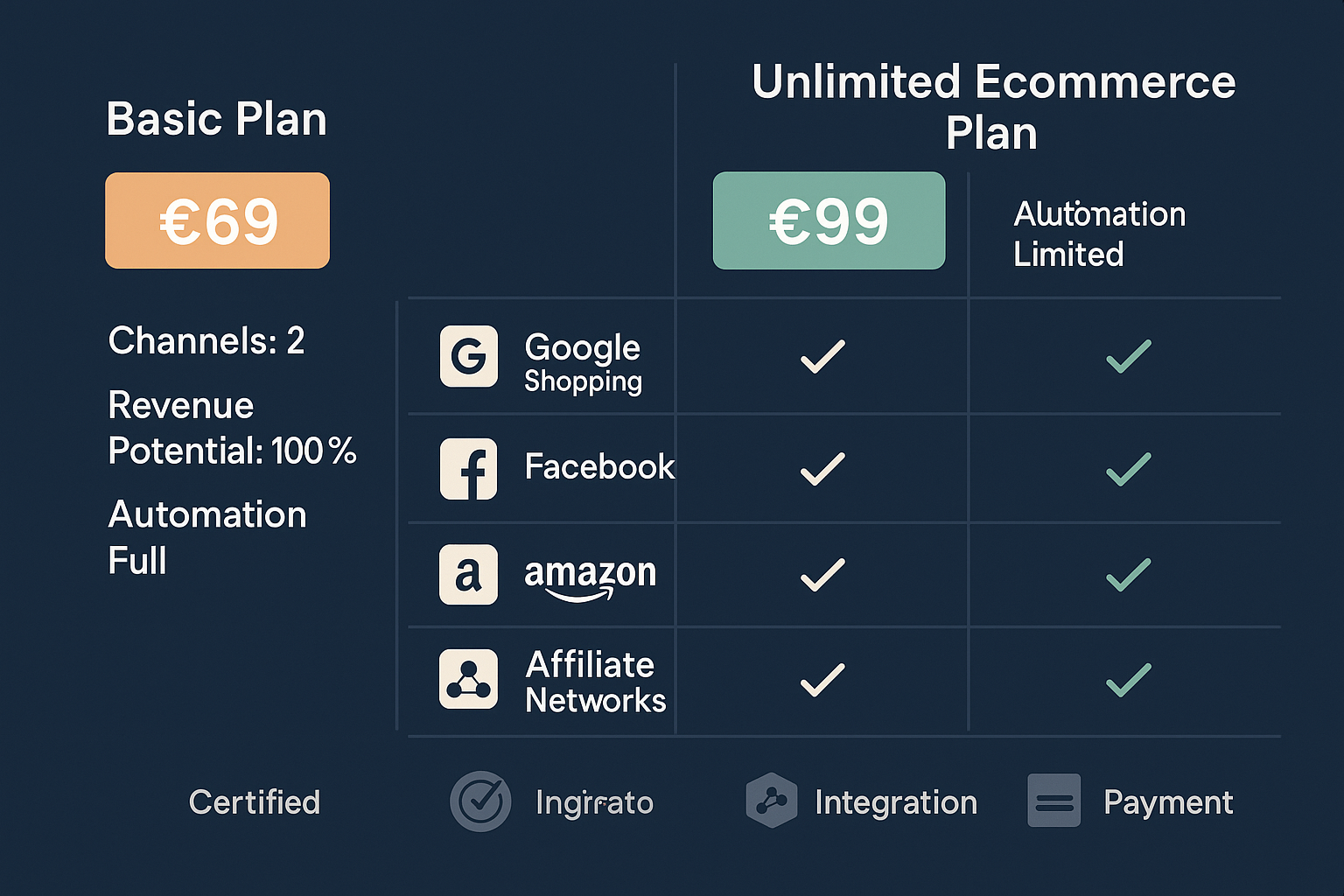
Direct side-by-side feature and value comparison of Basic vs. Unlimited plans clarifies what drives the €30 investment and its revenue impact potential
The Breakeven Threshold
The extensive data we’ve modeled shows that the unlimited channel capability pays for itself rapidly:
The Simplified Rule: For merchants with a standard 20% gross margin and an Average Order Value (AOV) of €75, the €99 Ecommerce Plan pays for itself when it enables just 2 additional sales per year on a new channel.
That’s not two sales per month, or two sales per week—it’s two sales, total, over twelve months. Given the immense reach of channels like Amazon and Facebook, achieving this minimum threshold is virtually guaranteed, making the choice an operational no-brainer.
Phase 1: Quantifying the Revenue Expansion (The 143% Uplift)
The most compelling argument for going multi-channel is the documented, proven impact on your store’s bottom line. The initial anxiety about complexity is swiftly overwhelmed by the statistical evidence of profitability.
Research confirms that merchants actively utilizing three or more sales channels see, on average, a significant 143.54% higher annual revenue compared to those stuck on one or two (Source C1). For medium-inventory sellers focused on leveraging automation (our sweet spot), that increase can spike to $323.53%$ higher revenue.
This isn’t just about throwing products onto arbitrary platforms; it’s about strategically targeting three distinct types of revenue that each new channel unlocks:
- High-Volume Transactional Revenue: Marketplaces like Amazon and eBay. Ideal for high sales volume even if margins are tighter.
- High-Intent Retargeting Revenue: Social commerce channels like Facebook and Instagram. Ideal for nurturing existing customer interest and driving higher Customer Lifetime Value (CLV).
- Low-Risk Incremental Revenue: Affiliate Networks (e.g., ShareASale, CJ Affiliate). Revenue is purely incremental, relying on partners to bring new, targeted traffic to your site.
Channel-Specific ROI Matrix
The value of the €99 plan is that it enables sophisticated integration across all these channel types simultaneously, ensuring your product feed is perfectly formatted for each one’s unique requirements (via our powerful smart attribute manipulation capabilities).
| Channel Type Unlocked by the €99 Plan | Primary Revenue Contribution | Impact on Store Growth | Why It Justifies the €30 Upgrade |
|---|---|---|---|
| Marketplaces (Amazon/eBay) | Maximize reach and scale; capture high-intent buyers already on the platform (Source C2). | Adds new customer base, increases total transaction volume. | Reach: A single profitable listing on Amazon can cover the entire €30 annual step-up cost in one month. |
| Social Commerce (Facebook/Instagram) | Retargeting efficiency, increased conversion rates, boost in CLV (Source C7). | Nurtures existing traffic, lowers overall Customer Acquisition Cost. | Efficiency: Enables advanced Dynamic Product Ads, generating highly targeted, low-cost revenue streams that are impossible with single-channel management. |
| Affiliate Networks | Introduces low-risk, performance-based incremental traffic from partners. | Purely net new site visitors and transactions. | Diversification: Opens access to new audiences instantly, achieving the critical multi-channel expansion that drives the $143%$ average uplift. |
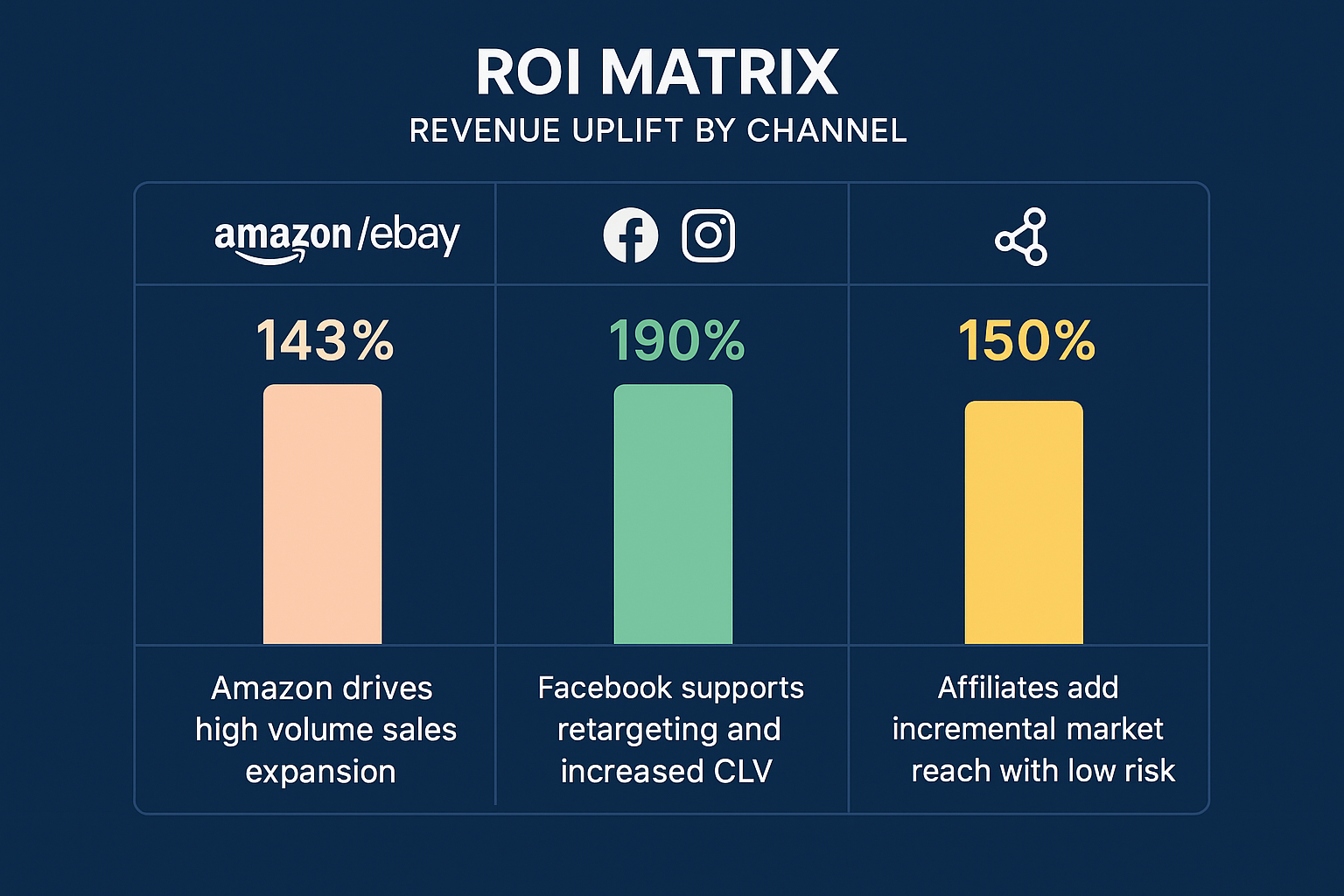 Shows how different channels contribute unique revenue benefits, quantifying the multi-channel advantage, justifying plan upgrade
This strategic expansion is the engine for growth. The data shows that even adding just one new channel historically increases revenue by 38%, and adding a third channel pushes that cumulative growth up to 190% (Source C4). The €99 plan is the technical gateway to make this expansion manageable.
If you’re ready to expand beyond Google, understanding how to configure your feeds for the specific needs of new platforms is paramount.
Phase 2: The Hidden Costs of Staying Small
Focusing only on the €30 cost difference can mask the far higher costs of inaction. These hidden costs fall into two categories: operational stability risk and manual labor debt.
The Cost of Vulnerability
Reliance on a single channel, no matter how dominant, exposes your business to existential risk (Source C3). Imagine the consequences for your revenue and cash flow if:
- Google suddenly changes its policy on product titles or attribute requirements, causing a three-day feed validation failure.
- A key partner platform experiences an outage.
- A competitor mounts an aggressive price attack within your single marketplace.
When you invest in the unlimited channels of the Ecommerce Plan, you are buying an operational safety net. If a niche affiliate network offers slow returns, you simply turn it off and activate Amazon without missing a beat, because all the feed management capabilities are centrally controlled and automated. The €99 plan is, fundamentally, an insurance policy against single-point failure.
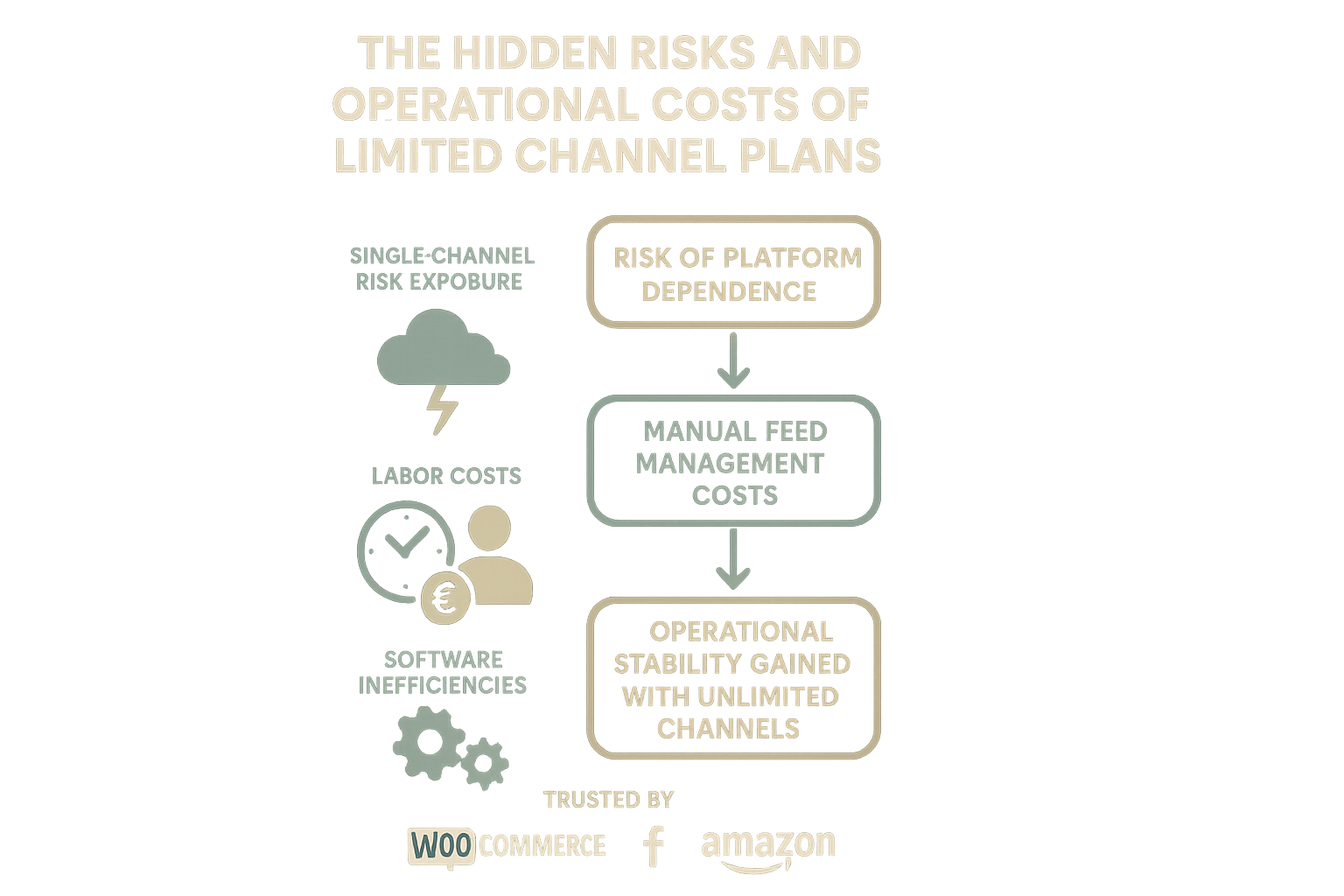 Visualizes the unseen dangers and costly manual efforts avoided by upgrading to the unlimited ecommerce plan, reinforcing the price as an operational safeguard
The Cost of Manual Labor vs. Automation
For growing WooCommerce stores, the alternative to automation is manual labor, and that quickly becomes prohibitively expensive.
Competitors dealing with enterprise clients cite substantial personnel costs involved in manual multi-channel maintenance—easily into the six figures when accounting for salaries, logistics, and management (Source C6). While your store might not require a $130,000 eCommerce director, the principle holds: every hour you or your valuable staff spend manually managing, cleaning, or debugging a multi-channel feed is an hour of lost focus on strategy, marketing, or product development.
The WP Marketing Robot Automated Updates feature, combined with unlimited channel access, ensures that every single platform—from a niche German comparison site to the expanse of Facebook—receives flawless, timely product data without human intervention. This feature alone drastically reduces the operational cost of multi-channel selling.
Phase 3: The True ROI Calculator: When €99 Pays for Itself
To move from justification to decision, we need to apply a simple mathematical framework. We will calculate the incremental sales needed to cover the €30 annual upgrade cost.
The Formula for Investment Justification
To calculate the Return on Investment (ROI) for the unlimited channel plan, we look solely at the incremental value:
$$\text{ROI} = \frac{[\text{Incremental Revenue from Unlimited Channels}] – [\text{Incremental Cost}]}{\text{Incremental Cost}}$$
Since the incremental cost is only €30 per year, the goal is simple: ensure the new channels generate more than €30 in incremental profit.
The Breakeven Table: Sales Required per Month
This table shows exactly how many additional sales you need to generate specifically from your new channels to fully cover the €30 annual price jump. We assume the sale is made only because you utilized a new channel (like Amazon, Facebook Dynamic Ads, or an affiliate network feed).
| Store Metric | Cost Increase to Justify (€30/year) | AOV of €50 | AOV of €75 | AOV of €100 | AOV of €200 |
|---|---|---|---|---|---|
| Gross Margin 10% | Sales Needed Annually | 6 sales | 4 sales | 3 sales | 2 sales |
| Sales Needed Monthly | 0.5 sales | 0.33 sales | 0.25 sales | 0.17 sales | |
| Gross Margin 20% | Sales Needed Annually | 3 sales | 2 sales | 1.5 sales | 0.75 sales |
| Sales Needed Monthly | 0.25 sales | 0.17 sales | 0.13 sales | 0.06 sales | |
| Gross Margin 40% | Sales Needed Annually | 1.5 sales | 1 sales | 0.75 sales | 0.37 sales |
| Sales Needed Monthly | 0.13 sales | 0.08 sales | 0.06 sales | 0.03 sales |
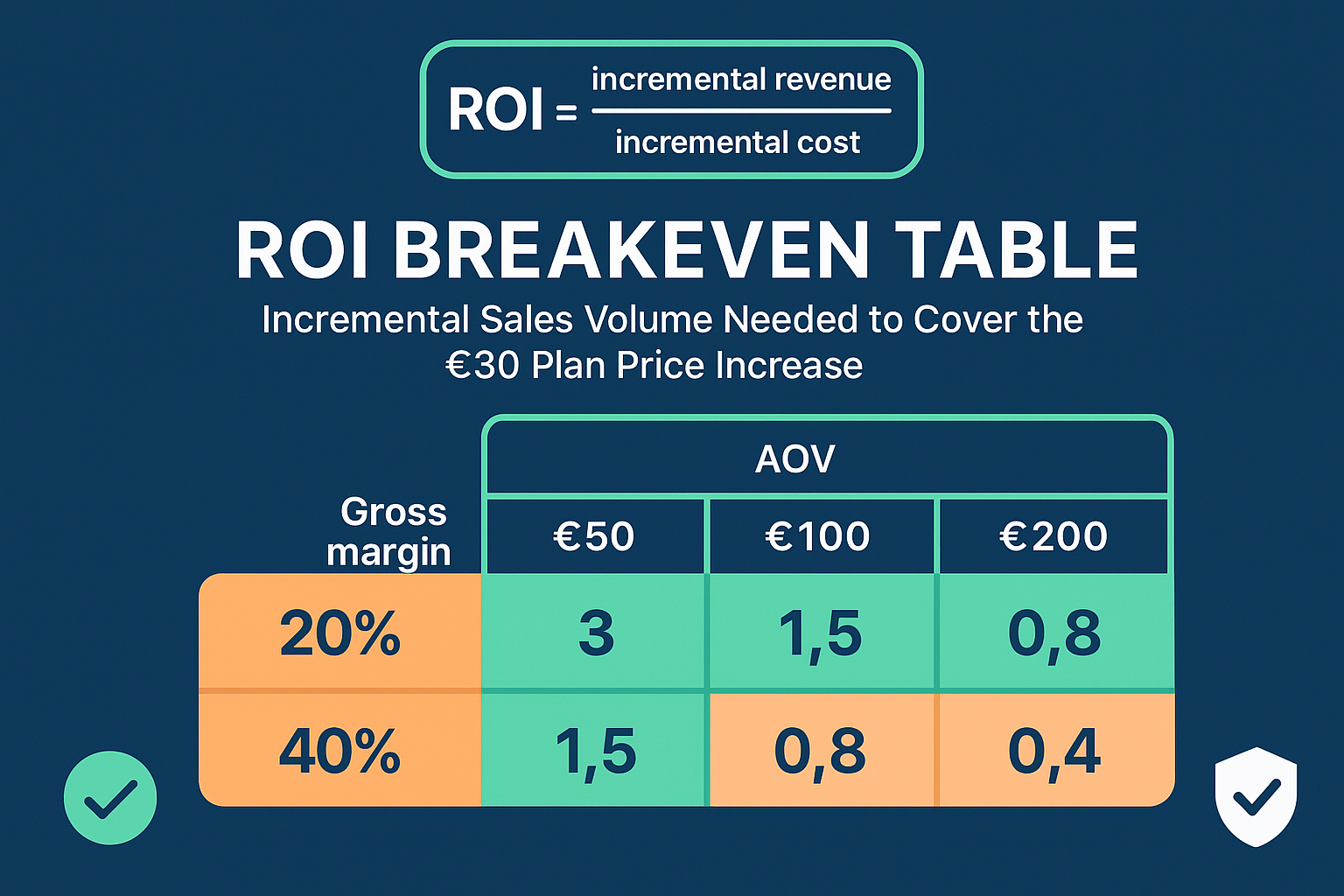 Calculates the exact number of new sales per month needed on new channels to offset the €30 monthly fee increase, providing a clear decision metric
Takeaway: If your store operates at a 20% margin and an acceptable €75 AOV, you only need to ensure the new channels (unlocked by the €99 plan) sell two extra units per year.
This dramatically reframes the issue. You are not asking if the €99 plan is “worth it”; you are securing access to highly profitable platforms while requiring near-zero incremental performance to break even.
Phase 4: Optimization: Maximizing the Unlimited Plan
The true power of having unlimited channels is not just turning them on, but customizing each feed to extract maximum profit. Your €99 investment unlocks the tools necessary for competitive channel optimization.
1. Master Custom Labels and Attributes
Every channel has idiosyncrasies. Amazon requires specific category trees; Facebook demands high-resolution images and availability status; and affiliate networks often need custom tracking parameters appended to URLs.
The WooCommerce Product Feed Manager allows you to refine product attributes using intelligent conditions. For instance, you can use Smart Attribute Manipulation to automatically adjust shipping costs for an Amazon feed, while applying a different set of product visibility filters only for your Google Shopping feed. This ensures compliance and drives maximum conversion rates on diverse platforms, a core competitive advantage.
2. Leverage Multi-Language and Multi-Currency
For those targeting international markets (a core driver of multi-channel growth), the Ecommerce Plan provides critical support for diverse languages and currencies.
This is more than just translation; it ensures that your German comparison sites receive feeds with localized pricing and text, maximizing relevancy and preventing cart abandonment due to unexpected currency conversions. This global flexibility is how you gain the crucial competitive edge over single-market sellers.
If you are using three or more channels, you must ensure that your entire ecosystem is integrated and performing efficiently.
Conclusion: The Investment in Stability and Growth
The switch to the Ecommerce Plan is a pivot from managing basic product visibility to executing a sophisticated, automated multi-channel sales strategy.
You gain powerful operational stability against platform volatility, you negate the steep costs of manual multi-channel labor, and most importantly, you position your WooCommerce business for the 143% revenue upticks that come naturally with market diversification.
Given how quickly the €30 annual investment pays for itself—often requiring as little as one incremental sale annually—the question shifts from “Can I afford the €99 plan?” to “Can I afford the strategic and financial risk of staying on a limited plan?”
WP Marketing Robot is your expert partner, providing the precise tools and automation to make this multi-channel expansion seamless and profitable.
Ready to unlock your full market potential? Explore the unlimited possibilities of the Ecommerce Plan today.

Leave a Reply
Want to join the discussion?Feel free to contribute!