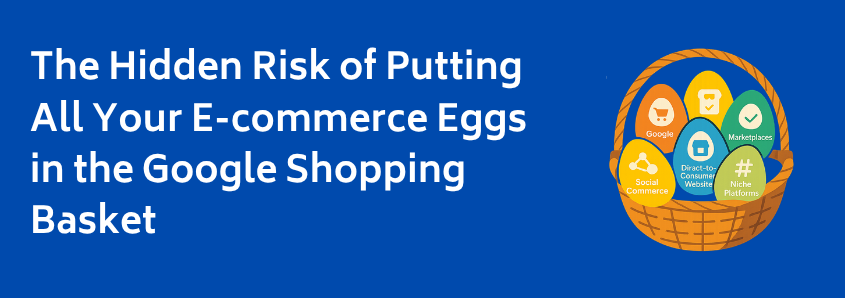
The Hidden Risk of Putting All Your E-commerce Eggs in the Google Shopping Basket
Your Google Shopping campaigns are performing well. The sales are rolling in, and your revenue chart is pointing up and to the right. It feels like you’ve cracked the code to e-commerce success. For many online merchants, this is the dream: a reliable, scalable channel that consistently brings in customers.
But what if that golden goose is also a golden cage?
Relying solely on Google Shopping for your sales is like putting all your fragile, valuable eggs into one very powerful but unpredictable basket. While it’s an incredible tool for growth, over-reliance creates hidden risks that can silently undermine your business, leaving you vulnerable to changes completely outside your control.
Let’s take a look under the hood and see why diversifying isn’t just a “nice-to-have” growth strategy, but an essential move for long-term survival.
The Illusion of Security: When Success Masks Vulnerability
It’s easy to become comfortable when a sales channel works. The metrics look good, the process is familiar, and the temptation is to double down on what’s effective. However, this comfort creates a blind spot. The ground beneath the entire e-commerce landscape is constantly shifting, and the biggest shifts are often dictated by Google itself.
Let’s explore the three key symptoms that prove your single-channel strategy might be riskier than you think.
Symptom #1: The Shifting Sands of Google’s Algorithm
You’ve probably heard of “Google algorithm updates.” In the past, these were mostly about search rankings. Today, they are much more profound. With the rise of AI, Google is transforming from a search engine into a personalized “shopping agent.”
Think about recent changes like the “Helpful Content Update” or ongoing Core Updates. Google’s goal is to understand user intent so deeply that it can present the perfect product directly, sometimes without the user even visiting your website. This shift, which experts are tracking as a move toward a “Universal Commerce Protocol,” means Google is becoming the primary decision-maker.
What this means for you:
- Loss of Control: Your product’s visibility is less about your website’s quality and more about how well your product data fits into Google’s new AI-driven model.
- Keyword Irrelevance: The game is moving beyond simple keywords. Google’s AI is matching products to complex buying signals, making it harder to “game” the system with traditional SEO.
- Constant Adaptation: What works today may not work tomorrow. A sudden algorithm change can cause your traffic and sales to plummet without warning, leaving you scrambling to figure out the new rules. The stress of keeping up with proper google shopping feed management becomes a full-time job.
Symptom #2: The Inevitable Rise of Cost-Per-Click (CPC)
Have you noticed your ad costs creeping up? You’re not imagining it. As more businesses flock to Google Shopping, the competition for ad space intensifies. This is simple supply and demand: more advertisers bidding on the same customers inevitably drives up the price you pay for each click (CPC).
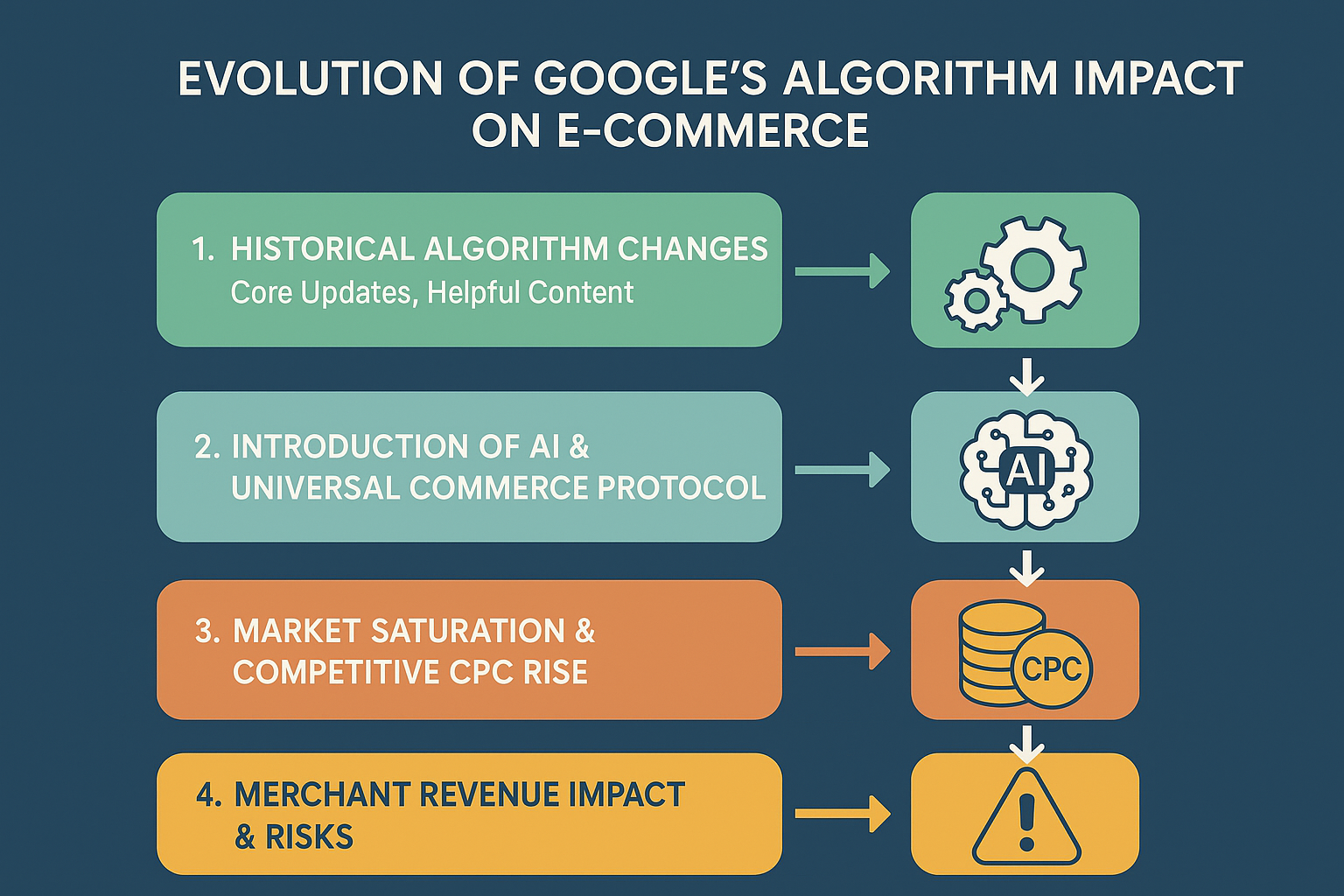
This is the “Cost of Convenience.” Google provides incredible access to customers, but as your reliance on it grows, so does your bill. Your profit margins begin to erode silently in the background. What was once a highly profitable channel can slowly become a break-even game or, worse, a loss leader. You end up spending more and more just to maintain the same level of sales.
Symptom #3: The Sudden Shock of Policy and Account Issues
Imagine waking up one morning to find your top-selling products have been disapproved or, in a worst-case scenario, your entire Merchant Center account has been suspended. The sales tap is turned off, instantly.
This is a terrifyingly common reality for many merchants. Google’s policies are complex and enforced by automated systems. A tiny, unintentional error can trigger a major problem. For example, a simple issue like a “mismatched value (page crawl) [price]” in Google Merchant Center, where the price on your site doesn’t perfectly match the feed, can lead to product disapprovals and lost revenue.
When Google is your only channel, these policy hiccups aren’t just annoyances—they are existential threats that can halt your cash flow overnight.
How Exposed Are You? A Quick Risk Assessment
Take a moment to honestly answer these questions. This isn’t about judgment; it’s about clarity.
- Revenue Concentration: What percentage of your total online sales comes directly from Google Shopping? (Is it over 50%? 70%?)
- Survival Test: If your Google Shopping traffic was cut in half tomorrow, would your business still be profitable?
- Profitability Trend: Are your profit margins from Google Shopping ads shrinking over time, even if revenue is stable?
- Customer Ownership: Do you have a direct relationship with your customers (like an active email list), or does Google “own” the connection?
If your answers make you feel a little uneasy, that’s a good thing. It’s the first step toward building a more resilient business.
The Antidote: Building a Resilient Business Through Diversification
The solution isn’t to abandon Google Shopping. It’s an incredibly powerful tool. The solution is to relegate it to its proper place: as one of several strong pillars supporting your business, not the entire foundation.
This is the core of a multi-channel strategy. By expanding to other platforms like social commerce on Facebook and Instagram, marketplaces like Amazon, or even niche channels specific to your industry you unlock powerful benefits:
- Resilience: An algorithm change or policy issue on one channel won’t cripple your entire operation.
- New Audiences: Different platforms attract different demographics, allowing you to reach new pockets of customers you would have otherwise missed.
- Reduced Acquisition Costs: Relying on a blended portfolio of paid and organic channels can lower your overall customer acquisition cost.
- Brand Building: A presence across multiple channels reinforces your brand identity and builds trust. This is one of the best ways for how to increase ecommerce sales sustainably.
The Real Challenge of Going Multi-Channel (And How to Prepare)
Diversifying sounds great in theory, but the execution can be messy. Each sales channel has its own unique requirements for product data. Facebook wants one set of attributes, Amazon needs another, and your niche marketplace demands something else entirely.
Suddenly, you’re not managing one product list; you’re juggling half a dozen, trying to keep them all in sync. This is where many merchants get stuck, leading to errors, frustration, and wasted time. The key is to see this challenge coming and prepare for it. True diversification requires a centralized system for effective ecommerce feed management.
Without a system, you risk poor WooCommerce reliability, stability, and performance, a review of which shows that manual updates and plugin conflicts are a major source of instability. It’s also important to remember that organic traffic is a channel in itself. Investing in creating store strong SEO links helps build a foundation that is not reliant on ad spend.
Frequently Asked Questions (FAQ)
What is a Google algorithm update, really?
Think of it as Google refining its rulebook for how it ranks and displays content, including products. These updates aim to improve the user experience by showing more relevant, helpful results. For e-commerce, this means Google is getting smarter about which products it shows to which shoppers, often using AI to predict what a person wants to buy.
Why are my Google Shopping costs going up?
It’s primarily due to increased competition. As more and more businesses use Google Shopping, you have more advertisers bidding for the same customer’s attention. This drives up the cost-per-click (CPC). Google’s business model is also based on ad revenue, so as the platform becomes more effective, the cost to use it naturally rises.
Isn’t diversifying to other channels too much work?
It can be, if you do it manually. The key is to use the right tools. Managing multiple product feeds by hand is inefficient and prone to errors. However, with a centralized product feed management solution, you can create and automate feeds for unlimited channels from a single source of truth, making diversification manageable and scalable.
Your First Step Towards a Future-Proof Business
You don’t need to overhaul your entire sales strategy overnight. The goal today is simply to shift your mindset from reliance to resilience.
Start by looking at your business through the lens of the risk assessment above. Acknowledge where you might be vulnerable. Then, begin exploring one just one new potential sales channel. Research where else your target audience spends their time.
By planting these seeds of diversification today, you’re not just chasing new sales. You’re building a stronger, more adaptable, and truly future-proof e-commerce business that can thrive no matter which way the digital winds blow.


Leave a Reply
Want to join the discussion?Feel free to contribute!